Showing posts with label class. Show all posts

22 November 2009

Vocab lessons

Thanks to medical school I now know:

- The annoying twitching that my left deltoid has been doing all day is called a fasciculation.
- My myopia will likely mean a later onset of presbyopia (compared to non-myopes).
- When I was a child I had a form of parasomnia (I sleep-talked; c'mon, who's surprised?).

- Neurologists like disorders with either 1) long names or 2) eponyms 3) both for the same syndrome (ex. acute demylinating polyradiculoneuropathy aka Guillian-Barre)
- Ophthalmologists also like long names, but prefer they end in "-ia" (ex. internuclear opthalmoplegia)

- If you eat contaminated pork, you can get pork tapeworm (T. solium), but if you eat a carrot contaminated by someone with pork tapeworm you get neurocysticercosis so cook those carrots good (see picture above).

- Laser Assisted Subepithelial Keratomileusis (LASEK) surgery involves shearing a flap into your cornea, while you are awake (with analgesic eye drops, picture).

- Anesthesia is technically only central nervous system depression. When you are put under you also get neuromuscular blockade (paralysis), analgesia (pain control) and amnesia (no memories).

- A symptom of hepatic (liver) failure or renal (kidney) failure is asterixis (characteristic hand flapping). It is likely accompanied by encephalopathy (altered mental status). Oh, and you're in danger of dying, soon.

11 November 2009

Pearls of wisdom

Recent quotes from lecture:

"Our country handles schizoid personalities very well. That's why we have software engineers, pathologists and Montana." -Dr. J

"Biopsying an aneurysm is not a successful procedure." -Dr. G

"If someone's head is cut completely off, that's not an emergency - that's a tragedy." - Dr. G

26 March 2009

The End of Anatomy

We had our anatomy closing ceremony today. After seven months and 32 labs of dissection, we have completed the anatomy curriculum. The occasion was marked by a series of awards, given out by the legend himself, Dr. Burkel, for the best anatomy students. I received recognition for setting up the practice exams for every sequence (with my colleague Zach).

One of the body donors had written a letter to the students who would be dissecting him and it was read to the whole class. It was a poignant and appropriate moment, but it was nevertheless awkward. While I try to be respectful of the body I worked on (I never cut of random body parts for fun or put him in strange poses), I simply cannot think of him as a living, breathing man while I'm sawing off his cheekbone or cutting his genitals in half.

Anatomy was a rite of passage, but I'm not unhappy it's over. It's important and valuable material, but it's simply not my favorite subject. I will miss the anatomy faculty, they are truly great teachers and interesting people.

Histology is also over, but that seems less momentous. Onwards to histopath! Only two sequences left... infectious diseases and development (and some clinical weeks in between). Two more months, then I'm an M2!

16 August 2008

Medical concepts made easy: #1

According to Dr. R, it is very important that we understand the concept of diapedesis; a phenomenon observed in the inflammatory response. So important, in fact, that he acted out the apparent struggle of a neutrophil trying to squeeze through an endothelial cell to attack a microbe (played by an M2). Popping across the stage in apparent success he yelled "I have diapedesed!" Later that night I felt the very same struggle when trying to cross a packed dance floor to get a glass of water. I couldn't help it, when we finally made it to the edge of the crowd, I turned to my roommate and said "I have diapedesed!"

Scientific definition: White blood cells migrating across the endothelium due to injury or trauma.
Real world analog: Crossing a packed dance floor due to thirst or heat.

05 December 2007

Organic Lab

Catalytic Hydrogenation of 4-cyclohexene-cis-1,2-dicarboxylic acid. We used a syringe to inject sodium borohydride while boiling the solution with chloroplatinic acid and activated carbon in a steam bath. The inflated balloon indicates that hydrogen gas is being produced and thus the solution is under pressure (sealed container).

It's exciting because I used a syringe. Twice.

27 September 2007

Spinal Innervation

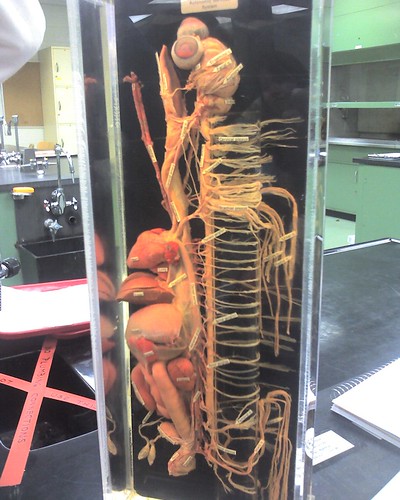
We did the entire spinal cord in one night in neuroanatomy lab. Granted, from a gross dissection point of view, a lone spinal cord is not much to look at. But when you consider the rather extensive innervation it becomes quite a daunting task.

Which organs, muscles, and body parts are innervated by which nerve tracts? How many interneurons for this system and what kinds of reflexes are involved? What will sympathetic or parasympathetic activation lead to? Which lamina of the vertebrae are receiving this type of input?

For those of you with some bio/neuro, recall that activation must also involve some reciprocal inhibition, so even a basic (monosynaptic) stretch reflex stimulates a cascade of firing.

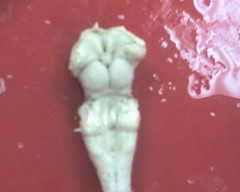
I think next week we move up the brainstem to the medulla (mylencephalon). And we'll get our exams back. Ick.

24 September 2007

Neuroanatomy


The first neuroanatomy exam is Wednesday so I am, of course, furiously trying to cram names like sulcus limitans and stria habenularis into my brain. I labeled photographs, I have made lists of key terms, I have flipped through slide sets and I have read the textbook and somehow this subject flummoxes me. Well, not the material itself, but rather, what is the best and most efficient way to study it?

It is great practice for medical school, where will have to learn more than just neuroanatomy. If I can figure out a strategy for this class then maybe I'll be a step ahead in general anatomy. If.