10 June 2008

Wedding weekend in nyc

The weekend in New York City was punctuated by a few fun highlights, not the least of which was staying in my friend's rather fabulous apartment near Columbus circle.

The ceremony and reception had about three hours in between them, so a few of us decided to find a local pub and grab a beer. The watering hole we ended up in had no draught beer and the bartender was taking bets on the payphone for Belmont. There was, however, a pool table. James managed to clear the table in a single turn (he broke and the rest of us didn't touch a cue).

The reception involved some classic dances moves: soulja boy, the roger rabbit, etc as well as 12 courses of yummy food. The wedding cake was an ice cream cake - a choice I fully and wholeheartedly endorse.

Post wedding we headed to Manhatten for a drink. We managed to grab a bottle of champagne from the reception and brought it, and a stack of paper cups, to the bar. We tried to pop it and drink it asap so as not to get caught, but get caught we did. We smooth talked the manager into waiving the corking fee by ordering drinks and shots and stayed out into the early am.

Congrats Jeff & Joanna!

05 June 2008

You know you have a problem when...

... you coworker buys you three pints for your birthday.

31 May 2008

Another stamp in my passport

Having just spent the last 6 days in the Riviera Maya, Mexico, I have arrived back in the US with a new stamp in my passport, a blotchy sunburn and a strong desire to sleep. There were 11 of us on the trip and we snorkeled, sunbathed, kayaked, rappelled, zip-lined, swam in a cenote, played water volleyball, and visited the Mayan city of Tulum.

I got a rather impressive sunburn on day 2, which has thankfully stopped hurting and started to turn more brownish than red. Don't get me wrong, I still look white, but now I can prove this is tan for me. The only part that has started to peel is my earlobes (I really did burn all over).

There was, of course, also plenty of partying. We spent one night in the resort's disco, which was so awful it was funny. They played rock around the clock and greased lightening, not exactly the clubbing music we're accustomed to. We spent another night in Playa Del Carmen, the local town, which was a mix of fun international chains (senor frogs - yay for the swing chairs) and local places (beautiful open air bars). We collected enough plastic cups to have our own flip cup tournament, but never ended up actually playing.

All around it was a really good time on beautiful beaches with great company. It will be nicely bookended with the upcoming trip to Alaska (July 4-11).

20 May 2008

Loose joints

With relative frequency one of my PIs points out small genetic aberrations I have - apparently my pupils are unequal, I have (benign) nystagmus and my nasal openings are narrow. If I had been developmentally delayed or ill these might have been taken in aggregate to try and identify a genetic diagnosis.

The latest finding was less direct. We were meeting a new patient and Dr. __ kept pointing out to me little things this girl could do that were more flexible than average. She could bend her fingers 90 degrees (see photo, my finger - you try), her elbows rotated more than 180 degrees and she would W-sit (sit like the japanese, then put your butt on the ground between your heels). I can do all of these things. At this point I am silently panicking... whatever this little girl has, I clearly have it too. Connective tissue disease? Autoimmune? I'm really a genetics case after all?!

None of the above. Turns out, to the degree we (little girl and I) have this flexibility is unusual, but not harmful. It can cause "clumsy kid syndrome" and mildly delay fine motor development, but prognosis is: normal kid. I've never been so glad to be normal.

14 May 2008

Drumroll please...

The deposit has been paid and all other applications withdrawn. Starting August 3, I will be attending the University of Michigan Medical School. Go Blue!

For the Lost addicts: This was foreshadowed years ago... when I was 6 and lost part of my finger in the door and it grew back ala Wolverine in X-men... and the Michigan football team is the... Wolverines.

13 May 2008

Everyone else is doing it...

Apparently I'm the last person to jump on the lets-get-back-in-shape bandwagon (but at least I jumped on). I tried going for a run this evening and tried is the correct word. Since a full length run is still a bit of a struggle, I've decided I'll do a short run in the am and a short run after work. I've further decided to declare this publicly so that I am motivated (by humiliation).

And yes, those are my running shoes.

Comings and Goings

I was up in NYC this weekend and while walking around saw a cage full of kittens waiting to be adopted. I have a huge soft spot for kittens (who doesn't?) and had to stand and coo for the requisite 5 minutes.

Otherwise, my lack of posting can be attributed to finishing up classes (they're done, hallelujah!), working lots (stupid NIH Progress report), major school choice indecision (UPitt vs UMich), and my discovery of Battlestar Gallactica (is it just me or are the cylons obsessed with sex?).

I'm trying to pull together an entertaining summer... starting with a few days in Mexico, then a friend's wedding in NYC, maybe some time in Cali (Northern and Southern) and hopefully a family vacation to Alaska. If anyone wants to go to Istanbul I think I could be convinced to make time for that.

Of course, somewhere in there will be moving to medical school; white coat ceremony Aug 3. For those of you who miss the travel posts, hopefully my summer will provide adequate fodder. Past Aug 3rd though, I think the distinctly medical/academic bent will return.

08 May 2008

Good, clean fun

According to this month's issue of Women's Health magazine, who heard it from the University of Cambridge student magazine, medical students have more sex than their other graduate school counterparts.

Field of study # of partners
Medicine 8
Political science 7
History 6
Language 5
Theology 2

20 April 2008

Reading medical memoirs

It is probably not surprising that throughout my post-bacc career I have been reading a series of medical memoirs, novels, and essays. There was House of God, which everyone reads at some point (and I have been told to re-read in residency), Better and Complications, both by Atul Gwande (he's kinda famous among the medical set), The End of Medicine (by a finance guy) and the Man who Mistook his Wife for a Hat (pop culture famous book on neurology by Oliver Sacks).

I recently started one by a female neurosurgeon, Katrina Firlik, and I am struck by how familiar it all is. I work in neurology, not neurosurgery, but I have seen many of the conditions she talks about. She didn't have to explain holoprosencephaly or hydrancephaly; I've seen them. I certainly don't have the knowledge base of peds neuro resident or even probably a well-educated, interested medical student, but I am conversant with the best of them on a limited subset of conditions.

The other theme that strikes me is that I have already begun the personal transformation that comes with being a physician. Dr. Firlik spends time explaining the sense of humor in the OR, the detachment of the physicians, the cold practicality that contributes to efficient care in times of crisis, but these paragraphs already ring hollow. They are exactly how I would explain it to someone on the outside, but there is really no way to make it ring true unless you've been there. Patients will never quite understand how you can tell them the worst news of their life and then spend an enjoyable afternoon hiking.

There are lot of things you don't realise when you start down this road to become a doctor, but this one might be the biggest, the most subtle, and the most significant. There is no undoing the change in how you view people and sickness; in this one way you will forever be apart from your non-medical peers.

18 April 2008

Leashes on kids

I must admit that subscribe to the idea best articulated on the Simpsons, "the leash demeans us both." But last Friday I met a mom who admitted to using a leash for her toddler and if I were her I would probably use one too.

Her child has a neurologic condition that, among other things, leaves her son both developmentally delayed and non-verbal. What this means is that while her son can walk and run and jump, he does not speak and has not yet learned common social cues.

The mom is clearly an involved and attentive mother, but as any mom or even babysitter can attest it is impossible to be watching every second of every day. What happens if she's paying for the groceries or using an ATM and he runs off? He can't say his name or who his mom is. He can't say where he lives or where he last saw his mom and we're not certain he would understand to look where he last saw her or follow a command given over a PA system.

Mom has sewn his name and address into all his clothes, just in case. She can't give him an ID necklace because he could hurt himself with it. He had a bracelet but he broke it - and the one before that. She's saving up to get one in a metal he can't break. What happens when he becomes coordinated enough to undo the clasp on it himself?

I don't think leashes are appropriate for most children, but I understand the trade-off here. I would also rather be the mom who gets stared at than the mom who loses her child.

14 April 2008

Shadowing cardiac anesthesia

First thing this morning I was standing in the middle of an honest to god surgical code.

The day started at 7:15am in the neonatal intensive care unit (NICU) for closure of a persistent ductus. The ductus arteriosus is a fetal vessel that connects the pulmonary artery to the aorta. It generally closes in the first few days of life; failure to do so can cause congestive heart failure. During the surgery, the ductus was severed from the aorta before it had been clipped, leading to massive bleeding (3-4x the infant's blood volume); the infant had no blood pressure or pulse for several minutes.

Here I should make several observations. First, the vessels in question are extraordinarily small and fragile in a newborn; looking at them wrong can cause them to tear (this was not a case of surgical malpractice). Second, it is not the surgeon who leads the resuscitation, it's the anesthesiologist. The surgeon is, of course, trying to stop the bleeding, but the person pushing blood and drugs through and controlling the chaos is the anesthesiologist. Third, codes are messy. By the time the infant was back there were empty syringes littering the floor and all available surfaces. At least 6 people had streaks of blood on them from loading or handling the syringes (they don't have needles, they are screwed into the IVs), there were towels everywhere, and there were twice as many physicians present at the end than when it all started. It's all hands on deck and I now understand why the prep beforehand is so specific and organized: everything gets labeled, unpacked, laid out in order, etc.

We went straight from the NICU to the OR, where the patient was already prepped and under for a VSD patch and interrupted arch repair. A VSD is a ventricular septal defect (hole in the wall between the two large heart chambers) and it gets covered by a small graft. An interrupted arch is a little more complicated (a gap between the ascending and descending aorta) to fix (create the missing piece of aorta out of native and other tissue) and requires bypass and deep hypothermic circulatory arrest (DHCA). The body is cooled to 18 deg. C and all blood flow is stopped while the aorta is repaired. It turns out that shadowing the anesthesiologist gives you an unparalleled view of the surgical field so I was staring straight into the chest the whole time (photo, right) and watched the heart be cut open, closed, cannulated for bypass, decannulated, and an aorta fashioned, all in less than 3 hours.

At this point we took a break to get some juice and crackers on the way back to the NICU to check on the morning baby - doing well (needs a head ultrasound to check for bleeding). We then headed up the cardiac ICU (CICU) to debrief the interrupted arch parents and meet our afternoon case.

The afternoon case was a pacemaker placement due to heart block. The parents were of the most over-zealous and anal retentive type and both the parents and the patient were all very heavy. Seriously, this kid had 20kg on me. This time I was there from the beginning and so witnessed prep and induction of anesthesia (including intubation). A sternal approach was chosen, which quickly proved difficult due to the child's weight. The surgeon was quite literally up to his wrists in adipose (fat) tissue before he could visualize any heart muscle (the leads are placed on the heart, the generator (photo, left) is placed at the lower edge of the ribcage). The first lead went on the first try. The second lead took two tries, but, success! The surgeon then hollowed out about a 1/3 cup of adipose tissue to make a pocket for the generator, which is about the size of a post-it note.

What struck me about both surgeries is now physical it is (breathing through a mask and standing still in one place for hours turns out to be harder than it looks) and how many more stitches it takes. If you think of a laceration that might bring you into the ER, you will get one layer of stitches. Closing the chest requires at least three layers of sutures; closing takes a good 15 minutes (depending on the size of the incision). I also noticed all the surgeons wore these nifty magnifiers clipped onto their glasses (no one seems to wear contacts) and headlights even with the the bright overheads. Lastly, the temperature in the OR is largely determined by the procedure - in a DHCA case the OR is cooled to help with cooling and then heated to help with rewarming. Oh - and no one played music.

Photos from google images. More about patent ductus arteriosus. More about interrupted aortic arch.

10 April 2008

Wiki project done!

I recently finished one of the cooler projects I've ever been assigned in school: to publish a fully-cited Wikipedia page on a biochemistry topic of our choice. My topic didn't end up being as biochemical as I originally thought, but my professor allowed me to finish the project anyway because I was so invested in the subject.

I chose to discuss Dentatorubral-pallidoluysian atrophy (DRPLA), a trinucleotide repeat, neurodenegerative disorder. It looks a lot like Huntington's and occurs with the same frequency in Japan, but it's extraordinarily rare in the West. Five families in the US have been identified; one of whom I met. The boy had the juvenile onset form (which presents with myoclonus - on EEG to the right) and passed away before he reached his 20th birthday.

To see my published page, type DRPLA into wikipedia or click here.

08 April 2008

Accidental photographer

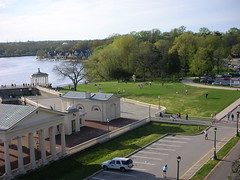
Apparently a photo I took while out one sunny day in Philadelphia has been selected as a finalist for a Schmap guide. This is the second time a photo of mine on Flickr has been noticed; a newspaper asked me for permission to use a photo I took of David Blaine in the fishbowl in NYC (remember when he lived underwater for 9 days in Lincoln Center?).

I'm generally not a talented photographer, but I guess blind squirrels really do find nuts once and a while.

06 April 2008

Idiocy of air travel

I flew out to Pittsburgh this weekend to re-visit the University of Pittsburgh School of Medicine. The flight to Pittsburgh was delayed two hours so my scheduled 7:10pm flight became a 9:10pm flight. There was another flight scheduled to leave at 9:00pm, also for Pittsburgh, which was running on time. After an announcement that the 9pm plane was not full, most of the people (including me) on the delayed 7:10pm flight rebooked onto the 9pm flight. At 9:10 they began boarding both flights simaltaneously. The delayed 7:10 flight was now practically empty, with fewer than 50 passangers booked, so I ran back to the counter and rebooked again, back onto the 7:10 flight.

I arrived in Pittsburgh at about 10:40 and headed straight to the tram that runs between the flight terminal and the baggage/ticket terminal. The tram broke down and we were stuck for about 20 minutes. Since we were in a tunnel our cell phones didn't work and no one was answering the emergency call button. Eventually the tram re-started and we made it to the baggage terminal.

I immediately headed outside to grab the bus into Oakland (a neighborhood in Pittsburgh) and watched one depart just as I got there. 30 minutes in the cold and another bus arrived (it's now a bit past 11:30pm). Who turns out to be on the bus? A former student of mine from when I was an economics TA who now hates his job in finance.

I did manage to get to my host MS1's apartment around 1am. I left my apartment at 5:10pm. That's almost eight hours and I didn't even leave the state.

31 March 2008

Clinic redux

Last Friday I shadowed an outpatient neurology clinic as I do once or twice a month; here are the highlights.

1. Childhood narcolepsy. This is diagnosed using a sleep latency test; abnormally quick decent into slow wave sleep indicated narcolepsy. Unfortunately, the normative data for children doesn't exist so it can be hard to definitively diagnose. An EEG is also a good idea to rule out seizures.

2. Autism. I've never seen autism to this degree before; the appointment was because of an increase in obstinate behavior. The child was barking intermittently and would lunge for any paper he saw (to eat it). He was pulling the threads out of his sweater and eating those too. The parents looked haggard and completely worn out; dad would jump at the slightest noise. Three clinicians saw the boy together to determine whether antipsychotics should be started or whether the current medications should simply have their doses tweaked.

3. Refractory status epilepticus. An adopted child who has failed five different kinds of anticonvulsants. In the last two weeks there have been no seizures, but the week prior there were two: 75 and 90 minutes in duration. An MRI and overnight EEG are on the table as the first step towards consideration of neurosurgery.

4. Cerebral palsy. Not usually something we see unless it's part of a larger issue, which, in this case, it was. We just don't know what the larger issue is. The part I want to bring up is that the leg muscles can get tight and force the knees to turn inwards. This realigns the hips; if left uncorrected, the hips can become painfully and permanently displaced.

5. Absence seizures with syncope. I have now met two children with this seizure type: they lose consciousness for the duration of their seizure. Invariably they are worked up by cardiology first and when they don't find anything, they send them to us and we hook them up to an EEG.

Daffofils

They evoke the strongest memory of school in England.

29 March 2008

Why so popular?

It mystifies me that the hands-down most often keyword-searched page on my blog is this post from July 26, 2006. It is far and away the most frequently visited page of my blog.

It turns out that if you google the words "screwdriver" and "chest," my blog comes up first. Cool.

Choosing a School

I am sitting in the law library (view from my chair, right) working on my biochemistry term paper on dentatorubral-pallidoluysian atrophy (DRPLA), but my mind keeps wandering. I have now heard from all my medical schools and must begin choosing where I want to spend the next four years. I have narrowed it down to three at which I have been accepted: Michigan, Mt. Sinai or UPitt or two at which I have been waitlisted: WashU or UPenn.

I am content to live in any of the above cities and they will all cost me about the same amount of money, so how do I choose? I am so paralysed by the decision that I have actually asked several of the attendings I know at the hospital to rank them for me (which they did: Upenn got 3 votes and WashU got 1 for the top spot).

I think what makes it so difficult is that I would be happy at any of these schools. All of them set me up well for the future; there is no wrong choice. I am extremely fortunate to be in this position and I recognize that. But I still have to choose. And I am still stuck.

In the meantime, this paper still needs to be written. Back to biochem.

25 March 2008

Neonatal pre-op MRIs

One of the research studies I am involved in at the hospital includes performing an MRI immediately prior to the heart repair surgery of TGA and HLHS babies*. The baby we studied yesterday was oversized (due to mom's diabetes), but otherwise stable. The MRI revealed PVL,** which we have seen in 20% of patients prior to their surgery, and also a temporal lobe hemorrhage. We immediately called the surgeon to the MRI suite and a discussion ensued: what is the bigger danger - delaying the heart repair or potentially enlarging the bleed (the surgery would involved heparin, a blood thinner)?

We decided to delay the surgery and re-image the child in a few days to re-evaluate.

Sitting in on that discussion reminded me why I want to be a doctor. I've been losing the faith a bit with all the paperwork that is my job recently and this year long illogical waiting game of frustration that is applying. It was nice to have a reminder; hopefully I will get another one this Friday in clinic.

- - -
*TGA = Transposition of the great arteries. The aorta is connected to the right ventricle and the pulmonary artery is connected to the left ventricle, creating two independent circulations.
HLHS = Hypoplastic left heart syndrome. The left ventricle fails to form and the aorta is small and insufficient. Once the ductus closes, there is no systemic circulation.
**PVL = Periventricular leukomalacia, a white matter injury that occurs in pre-mature babies and is thought to be associated with mild cognitive problems.

24 March 2008

23 March 2008

When I grow up

Now that I am settled on becoming a physician, the next logical decision is what kind of physician I want to be? Granted, there are rotations in third year to help me decide. I can shadow practitioners to make an informed choice and then, of course, I must match in the specialty I hope for. But what am I hoping for? Surgery? Emergency medicine? Pediatrics?

My colleagues that the hospital have their opinion: surgeon. My friends in their internships have theirs: neonatal intensive care.

But the best way to solve this problem is clearly to take some form of internet quiz. So I took the Medical Specialty Aptitude test on the University of Virginia Health System website. Apparently, my top 5 specialties are:
1. Nephrology
2. Thoracic surgery
3. Aerospace medicine
4. Plastic surgery
5. Pathology

I no longer put any faith in internet quizzes.

17 March 2008

Postscript to Mr. Jobs

My computer was returned to me, however it was not fixed. Additionally, there were four notches on the optical drive that were not there when I brought the computer in for servicing. While the return invoice lists two "parts or services used," the optical drive needed three attempts to eject the first disc I put in.

I must now send my MacBook back in. Since I cannot do this at the moment (I need it for school and work), I have opened a case with AppleCare and will send it in April. How many times I must I send it in before you either a) successfully fix it or b) replace it?

Regards,
S

13 March 2008

Dear Mr. Jobs

I have owned a series of Apple products over the years, but my most recent purchase (A MacBook) has caused me more headache than any PC I ever owned.

Shortly after buying it, it began leaking battery acid. There is no Apple store in Philadelphia and the Support team did not want to mail a toxic product so I had to ask someone to drive it into New Jersey for me to swap it for a new computer. No one at Apple transferred the Applecare to the new serial number so several months later when the hard drive spontaneously failed I had to spend a day on the phone proving that the policy covered this new machine.

The hard drive was replaced and Apple thoughtfully replaced several of the case panels as well. However, the panel that includes the optical drive was warped so when I got the computer back, it no longer ejected discs. I was in the midst of exams (and there is no Apple store in Philadelphia) so I waited three weeks until I could get to NYC to take it to a genius bar. Ruth (the genius) couldn't fix it in the store but she assured me that as a bounce-back repair it would be covered and I should have my computer back in 7 days.

It's day 5 and I just checked my status online. Apparently the repair has been on hold (since March 11, it's now the 13th) and no one called me, so I called Applecare. I spoke with Dan and Kendra and neither could tell me anything other than "wait for the depot to call you, they might not cover this repair."

I'm flabbergasted. Apple took it upon themselves to repair a part that was not broken and now, after a botched repair, won't fix their mistake. This is the third time this computer has needed repair! I need my computer to do my schoolwork and pay my bills - if there was a problem or delay, why did no one at Apple contact me?

I am purchasing a new computer this summer for medical school and the experience with this latest MacBook (less than 2 years old!) has forced me to seriously reconsider my stance on PCs. They might be equally much trouble, but they are much cheaper. If the product and service are going to be this poor either way, I might as well save my money.

Mr Jobs, I'm very disappointed. I think Apple makes innovative products, usually worth their higher prices. But apparently the quality and service are inverse to your company growth.

Please, fix my MacBook and send it back!

12 March 2008

Medical School Update

Because no, the process is still not over.

Applied: 23
Interviews: 13

Of the schools who gave me interviews:
Withdrawn: 2
Waitlisted: 2
Accepted: 5

Of the schools who have accepted me, I have declined 2.

As you can tell, I'm still waiting for 4 replies. I will be rejected by the 10 schools that didn't interview me (I received 6 of those letters already).

Deadline for the final decision: May 15th.

11 March 2008

Yummy!

We were talking about oatmeal chocolate chip cookies all day so when I got home I just had to make some. I didn't have any brown sugar so I used white sugar and maple syrup instead (and added a little extra flour) - they came out very moist and chewy... yum!

12 February 2008

Different and unequal

Nicholas Kristof took a break from the third world to write a column on the public perception of women leaders.

This creates a huge challenge for ambitious women in politics or business: If they’re self-effacing, people find them unimpressive, but if they talk up their accomplishments, they come across as pushy braggarts. The broader conundrum is that for women, but not for men, there is a tradeoff in qualities associated with top leadership. A woman can be perceived as competent or as likable, but not both.... Professor Duflo and her colleagues found that by objective standards, the women ran the villages better than men. For example, women constructed and maintained wells better, and took fewer bribes. Yet ordinary villagers themselves judged the women as having done a worse job, and so most women were not re-elected. Professor Duflo asked villagers to listen to a speech, identical except that it was given by a man in some cases and by a woman in others. Villagers gave the speech much lower marks when it was given by a woman.

In response there were the expected anti-Clinton posts, the sexism-is-dead posts, and the not-feminism-again posts, but the one that pissed me off enough that I had to write was this one (by Nathan N):

To think that gender or race is even remotely relevant and anything other than a complete “red herring” is an intellectual confusion. To illustrate my point, it may be interesting to wonder whether horses or oxes as a group run faster. But when you have one actual horse and one actual ox and want to know which one runs faster, all the statistics and knowledge about how fast or slow the members of the two classes of animals generally run become completely useless. All we need to do would be to let them race and see which one runs faster.
Actually, Nathan, I believe you are intellectually confused. And to boot, you totally missed the point. In your horse and ox example, Kristof's point would most closely be translated to the observation that even if the horse and ox raced with the same time, the ox would be thought of as the faster animal. In fact, your argument is negated by the example in Kristof's article - in an objective measure of governing fitness women did better but were kicked out more often.

Not to mention the fact that in a timed race there is an objective standard whereas a public election is not only subjective, but filtered by the media. The effects of this subjectivity are seen for both genders; some of the most qualified candidates lost early in the primary season due to a lack of media exposure and having more substantive credibility than stylish panache.

And to all the people who responded to his column, Kristof wasn't making a case for Hilary. He was making a statement about how in some situations democracies can empower the very prejudices the system is trying to protect against. If you're going to respond to an article, at least read it first.

28 January 2008

It's not all in my head

In medicine, we call it emesis. The other research assistants favoured the term "booting." Whatever you call it, I was holding the sides of a toilet and vomiting neon yellow bile yesterday one hour after watching a neonatal autopsy.

The baby in question was about one week old and died shortly after surgery to embolize a vein of Galen malformation. Basically, the baby was born with an extremely large vein in the brain -- this causes low blood pressures in the arterial system and high venous pressure (reversal of normal, also termed persistent fetal circulation). One potential repair is to fill the vessels feeding the oversized vein with glue (yes, literally glue) to lessen the amount of blood flowing through the malformation and restore normal blood pressures. This baby died shortly after surgery after two mysterious distended abdomen complications and difficulty ventilating.

An autopsy is not an elegant or a respectful procedure. The body is handled roughly, like an object, and no care is made to preserve the features that viscerally remind us of the corpse's humanity. The first part of the autopsy was an excision of the brain done with incisions from each ear to the center top of the head. The face is then peeled down and the skull cut into 4-5 triangles, which are peeled open like a flower to provide unhindered access to the entire brain. Unlike television, the baby bled when it was cut; this is not CSI, the bodies are not embalmed prior to examination.

Upon opening the skull it was immediately evident that there had been a substantial subdural and subarachoid hemorrhage (bleeding in the space between the brain and it's covering layers, the meninges). Thus, there was a lot of blood and it lots of gauze was required to visualize the venous system within the brain (you can see the vein of Galen by pushing apart the two hemispheres, gently). The spinal cord was then severed and the brain extracted and placed in diluted formalin to "set" for two weeks before the brain cutting (serial sectioning of the entire brain and spinal cord).

Once the brain is removed the face is pulled back up, but the skull is left open. The next question was what substance was filling the belly. To see whether it was air, the baby was submerged in a basin of water and a hole poked in the abdomen to see if bubbles would result. No bubbles. The body was removed from the basin and held upside down to let the (empty) skull drain (it filled with water when submerged: no brain, remember).

A Y incision was made, which is really more of a U from nipple to nipple and then a line down past, but around, the belly button. Care has to be taken not to cut to deeply, only skin and fat, not the organs beneath. Once you cut into the body, yellow liquid runs off - I think it's the water mixing with the fat (adipose) tissue.

A probe was used to spread the skin around the abdomen and below - the baby had no testicles in the scrotum so, where were they? Gently the intestines were pulled out (not all the way, just a bit) and nudged sideways so that there was a view of the interior of the body cavity. One of the intestines was brown (my guess: large) and the other more greenish (my guess: small), but both smooth and slimy. The testes looked like miniature pearl onions and they were floating off on the left side, not in the track they descend down so something was wrong there.

I didn't get to see then crack the chest because at that point we had to go see another (living) patient. Frankly, I think this was about as much as I could handle... I mean, this was a newborn and it didn't look dead.

While I was in there, watching, I felt mostly fine. I had a low level of queasiness, but I was interested in what I was learning about anatomy and pathology. My brain was on board, but my body was apparently not. I think there is something primal within that rejects the desecration of your own species and produces a visceral reaction. I was told you learn to control it, but that it never really goes away and to be honest, I'm glad. I'm even a little proud that I got sick (especially that I held it together until later, when none of the doctors could see) because it proved that despite my ability to be detached, I have not lost my empathy.

You're probably thinking... but you're going to do this in gross anatomy. Well, yes and no. One, those bodies are preserved (less blood). Two, they are skinned (much less human looking). Three, the faces are draped (again, less human looking). Four, they are adults, not babies. But, yes, I will have to touch dead bodies again.
And if I "boot" when I do it, I promise to tell you all.

20 January 2008

Why I sometimes don't like people

While waiting for the trolley this afternoon, I found myself standing near two young men and one older gentleman. In the five ish minutes we were waiting, all three of them spat at least twice. Which begs the question, when did it become kosher to spit in public? And not into a trash can, but onto sidewalks and public platforms. No one enjoys the spectacle of watching someone hock a lugie and I'm fairly sure no one wants to step on said mucus so why, oh why, do people spit in public? This is not the wild west - we are not all chewing tobacco and furnishing our living rooms with spitoons; I mean, come on, use a tissue, please?

15 January 2008

Bill Gates never took chemistry

Microsoft Word spell check suggestion for a-l-d-e-h-y-d-e: b-a-l-d-h-e-a-d-e-d.

14 January 2008

Get in the boat, fishes, jump in the boat!


First, 10 points to whomever gets the reference that is the post title. Not that the points are good for anything, but you can say you have them. Second, before I even describe the picture to the left: yes, I am aware that whales, even gray ones, are not fish. They are, in fact, mammals. Of the Baylean variety to be specific.

As you may have guessed by now the photo is of gray whales migrating off of the coast of California. The island shown is Anna Cappa, one of the Channel islands. This is about 15 minutes from where my parents live (well, the dock on the mainland anyway, it's another 40 by boat) so while visiting them we took a little romp on the ocean. Only one person on the boat got seasick, which is amazing, because it was so calm. Who gets seasick in calm waters on a sunny day?

The other photo is of sea lions (you can tell they aren't seals because they have ears): one male and one female. If you guessed the fat one is the male, you're right. I could insert a snarky comment here about why men are fat but in seals the women are the fat ones so it's a bit of a wash.

Next planned adventure in California: summer 2008: golf.

03 January 2008

Oh, the things we loathe

Tomorrow morning, first thing, I will go to the dentist. I would rather walk naked through the freezing streets of Philadelphia, but no, I will go to the dentist. I would rather receive ten tetanus shots, but no, I will go to the dentist. I would rather give up ice cream for a month, but no... I will go to the dentist.

They will pick and scrape and drill and I will squeeze my eyes and fists shut. I will repeat (to myself) over and over: it's a few hours, it's only a few hours.

Freshly numb, yet somehow still in pain, I will walk the six blocks west and lie down again. My mouth will stay shut, but my legs will spread as another doctor will poke and prod inside.

Sore on two ends and probably still drooling, I will go to work.

Help.

05 December 2007

Bummer

I had a little abstract prepared to submit to the Pediatric Academic Societies annual meeting (in Hawaii). It's customary to run these things by the Director(s) of the department(s) relevant to the abstract. Well, one of them killed my abstract. He won't let me submit it. Boo. And not because it's bad science, but because he's afraid we'll lose referral business.

Medical school admissions update

Left: Chasing sunset on a plane to St. Louis.

Applications completed: 23
Interviews offered: 12
Rejections: 3
Acceptances: 3

Organic Lab

Catalytic Hydrogenation of 4-cyclohexene-cis-1,2-dicarboxylic acid. We used a syringe to inject sodium borohydride while boiling the solution with chloroplatinic acid and activated carbon in a steam bath. The inflated balloon indicates that hydrogen gas is being produced and thus the solution is under pressure (sealed container).

It's exciting because I used a syringe. Twice.

26 November 2007

THE reason to get a Wii

Guitar Hero.

I played it for the first time this weekend.

A Mazing.

Even XKCD commented: Comic 70

Song added to my playlist because of Guitar Hero: Monsters by Matchbook Romance

Le Nozze Di Figaro

On Saturday night we headed to the Metropolitan opera to see Bryn Terfel and Simon Keenlyside in The Marriage of Figaro. It was a spectacular performance, but Anja Harteros stole the show. She played the Countess and received a longer standing ovation than either Terfel or Keenlyside. Her act II aria "Porgi, amor" and act III aria "Dove Sono" were riveting. Ekaterina Siurina was a lackluster Susannah in the midst of such a powerhouse cast; really only shining in her act IV aria "Deh! vieni, non tardar." It was only too apparent in the act III duet "Sull'aria" which soprano was carrying the show. There were two hilarious moments; one when a prop rolled off the stage and hit a cellist in the head (she finished the act and left), and another when Figaro motioned to Susannah to spank him in Act IV. Clearly, the Met and Terfel have a sense of humor.

On a different note, the dinner we had afterwards was also quite spectacular. Yum.

20 November 2007

17 November 2007

11 November 2007

Bacon or Chocolate?

In Vegas three of us discussed a theory that any food could be improved when accompanied by either bacon or chocolate. Some are an easy call: a turkey sandwich calls for some bacon while a cheesecake calls for chocolate.

Now I would have put Diet Coke in the chocolate column, but apparently I was outvoted because somewhere you can get Diet Coke with Bacon.

Question though... diet coke is kosher. Is diet coke with bacon?

In Boston?

This appears to be a wild turkey. He was just ambling around the block in the rough vicinity of MIT. I would posit that this is a dangerous time of year for a large, tasty turkey to be out for a stroll.

06 November 2007

...awkward...

About five minutes into my (non-Harvard) medical school interview...

Faculty interviewer: Have you ever been to Boston before?
Me: Yes, once. It's a great city.
Faculty interviewer: Was it to interview at Harvard medical school?
Me: ... yes.
Faculty interviewer: What did you think? You're exactly the type of person they like.
Me: Well, I think has good and bad qualities like every other school.
Faculty interviewer: What about UPenn, when are you interviewing there?
Me: I don't have an interview there.
Faculty interviewer: Yet. My daughter went there. She lived in University city. You don't want to live in the ghetto though. She almost went to Columbia, are you interviewing there?
Me: They have not invited me either.

I actually ended up liking the guy, but what a stressful start!

31 October 2007

A month of travel

Someone emailed to remind me I haven't posted in a month. True. And I have no excuse because my hotels had internet access. I was in Pittsburgh, Boston, and Atlanta to interview at medical schools and in Vegas to, well, blow off some steam.

For those of you keeping score, I have 9 interview invites, 2 rejections, and 12 haven't-heard-yets.

Tomorrow I have my neuroanatomy midterm (yikes) for which I am incredibly unprepared. This is partially due to travel and work and partially due to my going to Vegas instead of studying.

Vegas was phenomenal. I gambled (and won - Pai Gow!), first with someone else's money (what better way to learn) and then with my own. I ate (a lot), I sunned by the pools (tan = no, bikini debut = yes), I watched sports and drank beer in the sports book (go Steelers go Rockies), and I went clubbing (VIP, skybox: balcony over the dance floor = awesome). I took a red eye back, went straight to work and ended up in bed by 8:30pm (totally exhausted) for a nice 11.5 hour snooze. Four days of fantastic.

Flash back to now... sore arm from a flu shot, totally unprepared for a midterm, pre-lab to write and more travel to come. Oh, and I'm cold (not a surprise).

The next two weeks: Nov 5-6 Boston, Nov 7 NYC, Nov 12-13 Cleveland, Nov 15-16 Ann Arbour

If I get in somewhere (two letters potentially on their way) - you bet your cute little butt I'm gonna post.

27 September 2007

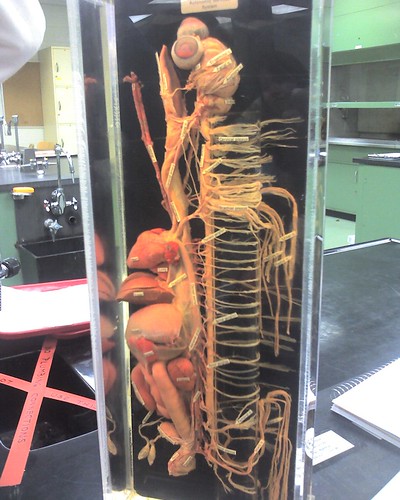
Spinal Innervation

We did the entire spinal cord in one night in neuroanatomy lab. Granted, from a gross dissection point of view, a lone spinal cord is not much to look at. But when you consider the rather extensive innervation it becomes quite a daunting task.

Which organs, muscles, and body parts are innervated by which nerve tracts? How many interneurons for this system and what kinds of reflexes are involved? What will sympathetic or parasympathetic activation lead to? Which lamina of the vertebrae are receiving this type of input?

For those of you with some bio/neuro, recall that activation must also involve some reciprocal inhibition, so even a basic (monosynaptic) stretch reflex stimulates a cascade of firing.

I think next week we move up the brainstem to the medulla (mylencephalon). And we'll get our exams back. Ick.

26 September 2007

Defending the men

Apparently there is a happiness gap between men and women: the women are less happy. When economists and readers of the New York Times were asked to explain the gap, the usual suspects were brought up: women are expected to do more (paid work and house work) and suffer under the societal standard of being and looking perfect. This whole problem was then laid squarely at the feet of the men and their apparent expectations and laziness.

This is totally unfair.

First, a huge percentage of what we do is to impress other women, not men. A decent proportion of these "standards" come from women's magazines - one big reason I don't read them. It's time to accept that you cannot and will not be perfect at everything and that the only person annoyed by that is you, not your husband/boyfriend/father.

Second, men do no expect us to look like supermodels all the time. In fact, there a lots of men who prefer a girl in jeans who will eat a burger and go for a hike than one who is in 3 inch heels, a mask of make-up, and refuses to eat non-lettuce items. And this cuts both ways, the perfect male physique is shown in movies (Brad Pitt) and on magazine covers, they have the same pressure we do.

Third, when was the last time you asked a guy to help with the housework? I am willing to bet if you sat down and divided the duties, you would be pleasantly surprised with how much they're willing to help out. In fact, I know plenty of men who are quite happy to stay at home more while the wife builds a career.

It's time we stop blaming men for our lot as women and shoulder some of the responsibility ourselves. Why are young girls unhappy? Because other girls are so mean (remember the book on sororities... girls can be vicious). Who is creating this pressure to be the perfect everything all at once? We are.

24 September 2007

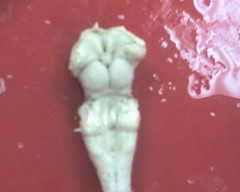
Neuroanatomy


The first neuroanatomy exam is Wednesday so I am, of course, furiously trying to cram names like sulcus limitans and stria habenularis into my brain. I labeled photographs, I have made lists of key terms, I have flipped through slide sets and I have read the textbook and somehow this subject flummoxes me. Well, not the material itself, but rather, what is the best and most efficient way to study it?

It is great practice for medical school, where will have to learn more than just neuroanatomy. If I can figure out a strategy for this class then maybe I'll be a step ahead in general anatomy. If.

19 September 2007

Medical school admissions update

# applications initiated: 27
# secondaries received: 25
# secondaries completed: 22
# confirmed complete apps: 20

# interviews offered: 6
# acceptances: 0
# rejections: 1

07 September 2007

I deserve a cookie.


A moment of victorious immodesty: I just cranked out a 115 page IRB protocol for constraint-induced movement therapy in 4.5 days.


update: It was pushed to the October 3rd review. : (

19 August 2007

Seen in NYC

"Beware of enterprises requiring new clothes." -Thoreau

Apparently, if you're dressed entirely in white, you can lawn bowl or play croquet on dedicated, manicured lawns in central park. Who knew?

Also seen in NYC this weekend: A man on a drag racing tricycle still living the funk, a dog wearing a pearl necklace collar, and a trumpet & tuba band playing (and wandering) the upper West side at 10:30pm.

Overheard in NYC this weekend:
uncle: I really like our hotel here. The location and service are great.
niece: Do we get HBO on demand?
uncle: I don't know.
niece: I don't like it then.

And to end... a nice bit of procrastination: me. Simpsonized.

10 August 2007

Paying doctors less

There was an article in the New York Times recently arguing that the best and fastest way to decrease the cost of health care in the short term was to pay doctors less. I think the best way to decrease health care costs is to pay lawyers less. After all, less pay means fewer lawyers, fewer lawyers means fewer lawsuits, fewer lawsuits means lower malpractice insurance, lower malpractice costs leads to lower patient care costs. And honestly, what part of society, health care or otherwise, wouldn't be better served with fewer lawsuits?

Regardless of my lawyer pay scheme, there are several important reasons not to lower the pay of doctors and arguably, to increase it.

First, becoming a doctor incurs more debt than any other profession so salaries are needed that can cover the cost of living and the cost of paying back loans. In 2006, the average medical student graduated medical school with $130, 571 in educational loans (that does not include loans to cover the cost of living, which average another $16,689) with 72% of graduates carrying a debt load greater than $100,000. That's an 8.5% increase over the previous year (1). Assuming a 5% interest rate, a graduate needs to budget $7,363 per year just to cover the interest on the loan.

Which brings me to the second point. Doctors make almost no money until after their residency. For example, the pay schedule for residents at UT Southwestern in Texas is listed below (2). That's a 3-4% increase annually, which barely tracks the current inflation rates (3). So a medical resident is carrying a six figure debt load and earning roughly the same salary as the maintenance workers (4) (who I assume have less school debt and little specialized training). Now lets consider that residents work at least 80 hours per week, while the maintenance worker pulls only 40. Hourly, a resident makes less than a babysitter. Compare that to a law school graduate who gets a job at a large law firm and receives an average starting salary of $99,000 (5).

Third, there is the effect on lifetime salary. While most twenty-somethings are paying nice sums into their401K and reaping the benefits of matching funds and compounding interest, medical graduates are paying all their money to their creditors. Considering the average entrance age into medical school is 24 (6) and most residencies are at least 3 years, a medical graduate will be 31 before they have a chance of receiving a salary that would allow them to save for retirement or pay off the principal on their loans.

Lastly, let's look at who in the medical field is getting particularly high salaries and why. Your GP is probably barely covering the cost of his/her practice, not making millions per year. At the hospital I work in, there are some doctors pulling seven figure salaries, but they are highly specialized: pediatric cardio-thoracic surgeons for example. That surgeon did 13-14 years of post-medical school training so he was in his forties before he made any money. If you paid doctors like him less, no one would go through the incredibly lengthy training, take on that level of risk, or be able to retire before 80.

There are a few rock star dermatologists or plastic surgeons who command high salaries, but there are a few people like that in every profession. Their wages are not indicative of the thousands of doctors practicing every day and those are the doctors that will be put out of business if salaries are lowered. Not to mention how many fewer bright young people will aspire to become physicians instead of bankers or lawyers. Paying doctors less is not the answer; the result from reduced pay is fewer doctors and therefore longer waits and a lowered standard of care.


Sources
(1) http://www.ama-assn.org/ama/pub/category/5349.html
(2) http://www8.utsouthwestern.edu/utsw/cda/dept200270/files/214265.html
(3) http://inflationdata.com/inflation/inflation_rate/CurrentInflation.asp
(4) http://www.co.monterey.ca.us/personnel/SalaryPost.asp?jt=72C19
(5) http://www.collegejournal.com/salarydata/law/
(6) http://www.vault.com/articles/The-History-of-Medical-Schools-in-the-U.S.-27653519.html

06 August 2007

Perpetually connected

I have joined the ranks of the perpetually connected... it's no longer my shadow and me, but instead, my Treo and me.

And I'm thrilled.

31 July 2007

YAY!

# of schools applied to: 25
# of secondaries received: 19
# of secondaries completed: 8
# of interview invites: 1

30 July 2007

Playing neurologist

I shadowed Dr. L in clinic recently and it turned out to be particularly eventful. The medicine itself is always interesting, but this time it was the patient's behavior that made it memorable. We saw a girl who was recovering from stroke for a routine follow-up examination. Throughout the exam she was staring straight at me and refusing to acknowledge a single question or command posed by Dr. L. After trying one last time to get her to follow his finger with her eyes, he sat down and looked at her. She finally looked him in the face, pointed an arm straight out at me and said "I want her to do it." Dan looked at me, nodded, and I walked over and stood in front of the girl. I have seen at least fifty basic neurologic exams performed and could describe it in lurid detail, but standing there performing it was absolutely nerve wracking. Dr. L was standing immediately behind me interpreting everything I was doing... I was in no way evaluating the patient; I was simply the body she interacted with.

The next patient was another female, clearly somewhat on edge. Dr. L introduced me and a visiting physician (also shadowing) and began a conversation with her. Three sentences in she announced "I know you don't think I'm going to discuss my business with all these people in the room." I promptly offered to leave to make her more comfortable, but she countered, "you can stay, but the other one has to go." The visiting physician left the exam room (I would later learn she was uncomfortable with men, as the visiting physician was male, it was simply a matter of gender). She began telling a (rather sad) story about recent events and while she was talking she curled up into a ball on the exam table. When Dr. L turned to get a pen from the desk, she hopped off the table, ran across the room to me, and gave me a bear hug. After a few minutes she released me and sat in my lap. The rest of the visit was conducted with her on my lap, one arm around my shoulders.

Most of Dr. L's patients have met me once, many of them at least twice now. Quite a few remember me when they come in and ask me how school is going, which is really quite remarkable to me. After all, I am silent most of the time, just watching and smiling. Apparently though, they are beginning to feel comfortable with me, which is a great feeling. I hope this carries over to my future career, that my patients feel they can trust me and be open the way these two girls were. The way all Dr. L's patients are with him.

29 July 2007

Summer sports

Since I'm not taking classes this summer, I've been trying to be more active. I don't have a gym membership, but that's really a good thing as I much prefer excersize that doesn't feel quite so pointless as running in place indoors. Instead, I've been playing lots of tennis and have taken up yoga - the kind done in a 95 degree room.

Tennis has been fantastic since so many people here play and it's super cheap for students. I'm now playing twice a week - one day of clinic and one day of matchplay with friends. I can feel my game getting a little better each time, which is really encouraging and just makes me want to play more. I'm working on learning a backhand slice approach shot and eventually I really need a better second serve.

Yoga has been quite the experience so far... I was incredibly sore all over after the first class, but the second was invigorating. It really is remarkably calming and I don't notice the heat at all. I'm relatively flexible, but I had no idea I was so weak! Well, maybe I had some idea, but this really confirms it!

When I was in Cali visiting my parents, I went rock climbing with a friend, Mike. It was really good fun and I'm hoping we'll go again when I head back there in late August. That's definitely a sport where I need to work on my upper body strength, but it's a great feeling when you get to the top of a route you didn't think you could do. Repelling down is pretty good fun too :)

09 July 2007

Medicine is already paying off

While in nyc to celebrate Swati's birthday, four of us piled into the back of a cab to get from the financial district to East midtown. Someone asked a question about research and I made some mildly medical comment in response. The cab driver then turns towards the backseat and says, "My hemoglobin is 9 and I have diabetes, should I be worried? What do I do?" I babbled something about glucose and blood transfusions (did he mean his hemoglobin level or his hemoglobin A1c?) followed by a strong wording of caution that I was only a student and that he should speak with his regular physician. His reply - "you are a very good doctor, I turn the meter off now."

A night in the city

It was a friend's birthday this weekend so I headed up to nyc for a celebration. Other friends from college, now in Ohio or D.C., also came up, turning this birthday party into a mini college reunion. I am ashamed to say I had been out of touch with some for two years; unless you count Facebook as meaningful interaction.
There was lots of laughter, a total of six cameras to record the event, and much frustration over the Duane Reeds in the financial district. If they all close at 6pm, where can a girl get some double-sided tape before a night out?
On the train on the way back I ran into a student from the weekly tennis clinic. He graduated to the super-secret, advanced clinic (I'm still intermediate) but after swapping stories for an hour on the railways we decided we could probably still play together. I'll just lose. Every time. Which is ok.

05 July 2007

Application update

Anyone who has been following this little blog over recent months knows that I am applying to medical school at the moment. Or rather, medical schools. My amcas has been verified and 23 schools now have my application... scary! I've begun working on secondaries, which pretty much just ask you to re-hash your amcas under different word count limitations.

Paperwork seems to be my theme at the moment (thus no cool medical stories) because work has been nothing but IRB and NIH reporting recently. Two of the three doctors in the group are away (Korea and Geneva) so all is quiet on the Neuro front.

04 July 2007

In the sunshine state

Going to visit my parents in southern California turned out to be the best decision I've made recently. My brother and two college friends were in attendance as well, so it was a bustling, full house. We baked bread pudding, which took about three hours, and ate fish, mexican, ahi tuna, and flank steak. We went through quite a few bottles of wine and soaked up the evenings in the hot tub watching for falling stars. We walked, we drove around in the convertible, we rock climbed (sore arms!) and we lounged around.
I'm not really ready to be back, but I guess that's the sign of a well-spent vacation.

25 June 2007

A real summer

For the last few weeks this little academic turned into a little socialite. There was tennis, bruchetta, wine, rum runners, bread pudding and strolls though the park. I'm hoping the tennis will continue, and I may be adding in yoga too.
I am hopping over to California for the July 4th weekend to see my family, and then hopefully up to NYC for a close friend's birthday.
In the fall my academic side will return with Nervous Systems lab (brain dissection class) and Organic Chemistry lab.
As much as I am loving the time to see my friends and the absence of exams, I am still not entirely sure what to do with myself when there is no homework!

For those of you not familiar with the rum runner:
1 shot dark rum
1/2 shot 151 rum
3/4 shot banana liquor
3/4 shot blackberry brandy
1/2 shot grenadine
3/4 shot lime juice

Drink slowly.

14 June 2007

My very own brain

This, to the left, is my brain. As in, the one in my head - the one I use every second of every day. Cool.

For those of you with no neuro background, let's name some structures.

1 Cerebellum
2 Medulla oblongata
3 Pons
4 Pituitary (right above the point of the 4)
5 Cortex
6 Splenium
7 Fornix
8 Septum pellucidum
9 Corpus callosum
10 Meninges: dura, arachnoid, pia

For the record, I have a normal brain for someone my age. The funny dark patch on the top of my head is cerebral spinal fluid (CSF), which is visible because the interhemispheric fissure was not fully perpendicular.

04 June 2007

Interventional Radiology

I shadowed a third year fellow in the cardiac cath lab today, watching two interventional procedures. The first was the expansion of a stenotic bicuspid aortic valve and the second was the closure of an atrial septal defect (ASD).

Note: The cath lab pictured is at Columbus Children's, not where I work. They look the same, though.

During the first case it took almost two hours to get access - meaning to establish a catheter in a femoral artery and femoral vein. In this case it was important to have both because we wanted to measure the blood pressure in the left ventricle and in the aorta. Ideally there is no difference; in our patient there was a 100 mm Hg gradient. This indicates that the aortic valve is very stenotic (narrow) - a condition that eventually requires a valve replacement. Valve replacements in children are to be avoided so there are two ways to buy some time: 1) expand the valve with a balloon in a catheter procedure or 2) open the chest and scrape the valve in surgery. The procedures carry approximately the same rate of complication, but each carries a different complication. Surgery generally leaves residual stenosis and interventional radiology tends to produce aortic insufficiency (backwards flow through the valve from the aorta into the ventricle).

The second case involved using a yo-yo looking instrument to plug a hole in the septum separating the two atria. If you look closely at the picture to the right you can see it in the top, just right of center. Once the catheter enters the heart, it is threaded through the hole (technically called a patent forman ovale, patent indicating open) and the first half of the yo-yo is deployed. The catheter is retracted through the hole and the second half of the yo-yo is deployed. It's very important that the placement is correct because otherwise it could loosen and go bumping around the heart or even enter the systemic circulation (depending on the size and type of closure device used).

Interestingly, you cannot actually see the outlines of the heart when doing a cath procedure. All the monitors carry continuous x-ray images and if you've seen an x-ray before you know that it's nearly impossible to see tissue with any resolution. That's how well these guys know the heart. They can tell by the ribs and chest cavity around it exactly where they are inside it. When appropriate, they will use a simultaneous ultrasound though (on which you can see tissue and blood flow).

At the end of the day, I'm not sure this is my new specialty of choice. It was incredibly cool to see and the people who work in the group were really fun (the atmosphere resembled a sports team pre and post game), but the patients are sedated the whole time you are with them and man, those lead aprons/vests/thyroid glands are heavy and hot!

21 May 2007

Notes from a long weekend

Borrowing from TWM... a few notes that came to me while (finally) relaxing for a long weekend.

  • Shrek 3 is the funniest of the Shrek movies and it deserves kudos for not becoming a 120+ minute epic. Bonus great preview: Ratatouille.
  • Spiderman 3 had a few thrilling moments, but they were so diluted by the marathon length of the film that ultimately its not worth the $12. If you must, Netflix it.
  • A friend of mine was brutally attacked by a classmate last week. You just don't think these things happen to the people you know... but then it does. Get well L____.
  • I went to three brain autopsies last week - very cool. I may have to turn this into a full post once I look up some more about kernicterus.
  • I saw Atul Gwande speak last Tuesday. He is a charismatic man who writes medical stories with the same flair Levitt and Dubner brought to economics. If you need a good book, I highly recommend Complications or Better.
  • Grey's Anatomy, much to my dismay, has become the Desperate Housewives of medicine. Remember when they had patients? Remember when there was actually some medicine on the show? On the other hand, I am loving Stanley Tucci on ER.
  • Ben & Jerry's recently updated their flavours. I am happy to report strawberry cheesecake is alive and well and I am quite enjoying the new Willie Nelson's peach cobbler.

20 May 2007

Hear me roar

Fortune has an article in it's current issue describing the entrance of Gen-Y into the post-collegiate working world. Apparently we are the most demanding, least loyal, most connected, least apologetic generation to date. That sounds about right.

I am a prototypical Gen-Yer. I left my cushy banking job for exactly the reasons this article outlines: I did not have a sense my career was moving anywhere. I did not feel like I was doing any meaningful work. I had no real responsibility. In fact, I had more responsibility running the job fair for my university than I had at work; why would anyone stay at a job that feels like a demotion?

We did have international training exercises, which were a good idea: we networked with other young hires at the bank and got a sense of the global business. Our mentors on these exercises were upper management (again, good idea). But there was no follow-through. We would perform well, get fantastic feedback, and go back to 60 hour weeks pushing F10 and occasionally F12.

I was willing and ready to work 80 hour weeks and solve real problems. Hard work and little work-life balance were fine with me if I had a sense I was invested in my job, if I felt like I was needed and making a contribution. I wrote a strategy paper on how to make our entire North American derivatives business client focused and the comment I received back was: it's 200 words too long. In true Gen-Y style I cut 203 words from one section and replaced them with "see Appendix C". Then I quit.

If I'm going to "do my time" I'm at least going to do it somewhere I can make a difference. I am training to become a physician and during my internship and residency, my "slog", I will at least be making a contribution to the health of the people I meet. It may be a smaller scale than global finance, but it's also a more meaningful one.

I expect great things of myself. Call it hubris, but I find it insulting if you expect less of me than I do. I do not accept that I should work at less than my full capacity because I am young. Age should not determine responsibility; ability should. I am superwoman.

And apparently there are 79.8 million of me.

02 May 2007

Where are you from?

I have always found this to be a particularly difficult question. And I always thought this made me weird. Nationality, or a defining point of origin, is central to our way of identifying ourselves and each other. But how do I answer it? I have two passports, where I was born is not where I lived the longest, my first language is not my best language and I am an immigrant to my father's country.

While browsing Wikipedia while studying for my organic chemistry final I came across something startling: I am not the only one. Ok, so that's not the surprise of the millenium, but I certainly did not think that people who had grown up in multiple cultures would be a unique sociological group. But we have a name: Third Culture Kids.

15 April 2007

Quirks

A little while ago TWM referenced (and a long while ago responded to) a short meme asking what he didn't like that most people did. I thought it an interesting topic of conversation and brought it up at work, where it has now become a common non-sequiter to mention an example as it pops into our heads. Here, for prosperity's sake, are a few of my own.

1. Cheese - I can't stand it. To the point where it makes me physically ill. It could be an allergy or it could just be years of loathing that have conditioned a physical response.
2. Shrek - yeah, it just wasn't that great. For me. I didn't laugh, I didn't cry... I just yawned a bit.
3. Bob Marley - his music simply irritates me. It drains my patience.
4. Doughnuts - it's something about the texture.
5. Lying on the beach - it's boring and I always always always end up sunburned.


And to add a category: things I love that other people don't seem to:

1. Neck ties - I think they look distinguished and polished. If girls didn't looks like want-to-be punk rockers in them, I would wear one with my suit.
2. Oxfords - Men have an abundance of choices for this shoe, but what happened to the women's oxford?
3. English food - scones, custard, treacle tart, bangers and mash, fish and chips, cottage pie... what's not to love?


Oh, and pet peeves is a good one too (now I'm just getting carried away):

1. Using the "is" with a plural noun (even if you pronounce it as a contraction, "there's", it's still wrong).
2. Riding the elevator down one floor (um, stairs?).
3. Answering your cell phone in the middle of a conversation with someone who is physically sitting with you.

14 April 2007

On becoming a American Democrat

Despite being a citizen from birth, it took me a long time to become an American. I was born abroad, lived my elementary years and happiest teenage years in the United Kingdom and have travelled extensively throughout my life. As a result, I was able to see America through the eyes of the rest of world: as a materialistic, selfish, ignorant and greedy brute. For years I held tightly to my European identity, steadfastly refusing to be lumped in with the rest of the American herd.

Of all the things that could make me look past the surface of what it means to be an American, it was a popular tv show that changed my mind. The West Wing, and not my AP US History class, showed me the power of what is written in the US constitution. For all the idiotic ways it's thrown about (freedom fries anyone?) freedom really is a powerful concept. Similarly, the separation and balance of powers. If you don't get a sense of awe when you think about our constitution, I suggest you take a course on world politics or rent a few seasons of West Wing.

I will admit that my father is a republican and I inherited my first political ideals from him. But even as I began to formulate my own, there was a lot to love about the republican party. I'm not talking about Bush Jr. and what you read in the NYT each morning, I'm talking about what the republican party originally stood for: individual liberty. To be a republican was to believe that people behave best when they are allowed to choose for themselves. That government should not legislate a moral agenda and that the constitution must be held sacred.

Unfortunately, the current version of the republican party more closely resembles the Catholic church in the middle ages than the founding ideals of the republicans. Apparently we are no longer capable of teaching our children morals, so we should put the 10 commandments in schools (violating the separation of church and state in that sacred constitution). Apparently the freedom of choice does not include those who disagree with what you would do with that freedom; if you are going to have gay sex or abort your pregnancy, you should no longer have the right to make your own choices. Apparently people cannot even be trusted with information, because if teenagers were taught to use a condom, they would all be having porn-style sex daily.

Let's not forget that one of the tenants of Christianity is to convert the non-believers. Our foray into Iraq is the ultimate mission - restyle the country in our own image. Bush's use of the word crusade may have been more appropriate than we are comfortable with.

His administration at home is run like the old church too - sealed executive orders, favours to friends, corruption, scandal, and a host of falsely accused victims (the attorney generals who where fired for... anybody?). His appointees appear to be chosen on the basis of their religion and not their resumes (Paul Krugman wrote an great editorial on this in the NYT).

And so I cannot, in good conscience, support the republican party. If I must institutionalise something, I would rather codify deed than thought. I would rather legislate welfare than religion and I would rather sacrifice free markets than free choice.

West Wing made me an American and evangelicals made me a Democrat.