31 October 2007

A month of travel

Someone emailed to remind me I haven't posted in a month. True. And I have no excuse because my hotels had internet access. I was in Pittsburgh, Boston, and Atlanta to interview at medical schools and in Vegas to, well, blow off some steam.

For those of you keeping score, I have 9 interview invites, 2 rejections, and 12 haven't-heard-yets.

Tomorrow I have my neuroanatomy midterm (yikes) for which I am incredibly unprepared. This is partially due to travel and work and partially due to my going to Vegas instead of studying.

Vegas was phenomenal. I gambled (and won - Pai Gow!), first with someone else's money (what better way to learn) and then with my own. I ate (a lot), I sunned by the pools (tan = no, bikini debut = yes), I watched sports and drank beer in the sports book (go Steelers go Rockies), and I went clubbing (VIP, skybox: balcony over the dance floor = awesome). I took a red eye back, went straight to work and ended up in bed by 8:30pm (totally exhausted) for a nice 11.5 hour snooze. Four days of fantastic.

Flash back to now... sore arm from a flu shot, totally unprepared for a midterm, pre-lab to write and more travel to come. Oh, and I'm cold (not a surprise).

The next two weeks: Nov 5-6 Boston, Nov 7 NYC, Nov 12-13 Cleveland, Nov 15-16 Ann Arbour

If I get in somewhere (two letters potentially on their way) - you bet your cute little butt I'm gonna post.

27 September 2007

Spinal Innervation

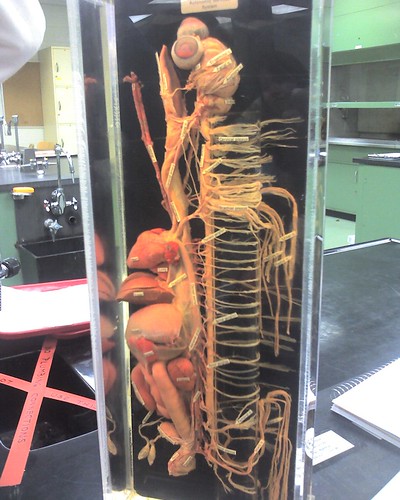
We did the entire spinal cord in one night in neuroanatomy lab. Granted, from a gross dissection point of view, a lone spinal cord is not much to look at. But when you consider the rather extensive innervation it becomes quite a daunting task.

Which organs, muscles, and body parts are innervated by which nerve tracts? How many interneurons for this system and what kinds of reflexes are involved? What will sympathetic or parasympathetic activation lead to? Which lamina of the vertebrae are receiving this type of input?

For those of you with some bio/neuro, recall that activation must also involve some reciprocal inhibition, so even a basic (monosynaptic) stretch reflex stimulates a cascade of firing.

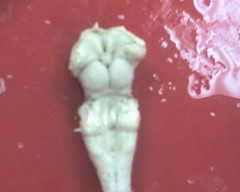
I think next week we move up the brainstem to the medulla (mylencephalon). And we'll get our exams back. Ick.

26 September 2007

Defending the men

Apparently there is a happiness gap between men and women: the women are less happy. When economists and readers of the New York Times were asked to explain the gap, the usual suspects were brought up: women are expected to do more (paid work and house work) and suffer under the societal standard of being and looking perfect. This whole problem was then laid squarely at the feet of the men and their apparent expectations and laziness.

This is totally unfair.

First, a huge percentage of what we do is to impress other women, not men. A decent proportion of these "standards" come from women's magazines - one big reason I don't read them. It's time to accept that you cannot and will not be perfect at everything and that the only person annoyed by that is you, not your husband/boyfriend/father.

Second, men do no expect us to look like supermodels all the time. In fact, there a lots of men who prefer a girl in jeans who will eat a burger and go for a hike than one who is in 3 inch heels, a mask of make-up, and refuses to eat non-lettuce items. And this cuts both ways, the perfect male physique is shown in movies (Brad Pitt) and on magazine covers, they have the same pressure we do.

Third, when was the last time you asked a guy to help with the housework? I am willing to bet if you sat down and divided the duties, you would be pleasantly surprised with how much they're willing to help out. In fact, I know plenty of men who are quite happy to stay at home more while the wife builds a career.

It's time we stop blaming men for our lot as women and shoulder some of the responsibility ourselves. Why are young girls unhappy? Because other girls are so mean (remember the book on sororities... girls can be vicious). Who is creating this pressure to be the perfect everything all at once? We are.

24 September 2007

Neuroanatomy


The first neuroanatomy exam is Wednesday so I am, of course, furiously trying to cram names like sulcus limitans and stria habenularis into my brain. I labeled photographs, I have made lists of key terms, I have flipped through slide sets and I have read the textbook and somehow this subject flummoxes me. Well, not the material itself, but rather, what is the best and most efficient way to study it?

It is great practice for medical school, where will have to learn more than just neuroanatomy. If I can figure out a strategy for this class then maybe I'll be a step ahead in general anatomy. If.

19 September 2007

Medical school admissions update

# applications initiated: 27
# secondaries received: 25
# secondaries completed: 22
# confirmed complete apps: 20

# interviews offered: 6
# acceptances: 0
# rejections: 1

07 September 2007

I deserve a cookie.


A moment of victorious immodesty: I just cranked out a 115 page IRB protocol for constraint-induced movement therapy in 4.5 days.


update: It was pushed to the October 3rd review. : (

19 August 2007

Seen in NYC

"Beware of enterprises requiring new clothes." -Thoreau

Apparently, if you're dressed entirely in white, you can lawn bowl or play croquet on dedicated, manicured lawns in central park. Who knew?

Also seen in NYC this weekend: A man on a drag racing tricycle still living the funk, a dog wearing a pearl necklace collar, and a trumpet & tuba band playing (and wandering) the upper West side at 10:30pm.

Overheard in NYC this weekend:
uncle: I really like our hotel here. The location and service are great.
niece: Do we get HBO on demand?
uncle: I don't know.
niece: I don't like it then.

And to end... a nice bit of procrastination: me. Simpsonized.

10 August 2007

Paying doctors less

There was an article in the New York Times recently arguing that the best and fastest way to decrease the cost of health care in the short term was to pay doctors less. I think the best way to decrease health care costs is to pay lawyers less. After all, less pay means fewer lawyers, fewer lawyers means fewer lawsuits, fewer lawsuits means lower malpractice insurance, lower malpractice costs leads to lower patient care costs. And honestly, what part of society, health care or otherwise, wouldn't be better served with fewer lawsuits?

Regardless of my lawyer pay scheme, there are several important reasons not to lower the pay of doctors and arguably, to increase it.

First, becoming a doctor incurs more debt than any other profession so salaries are needed that can cover the cost of living and the cost of paying back loans. In 2006, the average medical student graduated medical school with $130, 571 in educational loans (that does not include loans to cover the cost of living, which average another $16,689) with 72% of graduates carrying a debt load greater than $100,000. That's an 8.5% increase over the previous year (1). Assuming a 5% interest rate, a graduate needs to budget $7,363 per year just to cover the interest on the loan.

Which brings me to the second point. Doctors make almost no money until after their residency. For example, the pay schedule for residents at UT Southwestern in Texas is listed below (2). That's a 3-4% increase annually, which barely tracks the current inflation rates (3). So a medical resident is carrying a six figure debt load and earning roughly the same salary as the maintenance workers (4) (who I assume have less school debt and little specialized training). Now lets consider that residents work at least 80 hours per week, while the maintenance worker pulls only 40. Hourly, a resident makes less than a babysitter. Compare that to a law school graduate who gets a job at a large law firm and receives an average starting salary of $99,000 (5).

Third, there is the effect on lifetime salary. While most twenty-somethings are paying nice sums into their401K and reaping the benefits of matching funds and compounding interest, medical graduates are paying all their money to their creditors. Considering the average entrance age into medical school is 24 (6) and most residencies are at least 3 years, a medical graduate will be 31 before they have a chance of receiving a salary that would allow them to save for retirement or pay off the principal on their loans.

Lastly, let's look at who in the medical field is getting particularly high salaries and why. Your GP is probably barely covering the cost of his/her practice, not making millions per year. At the hospital I work in, there are some doctors pulling seven figure salaries, but they are highly specialized: pediatric cardio-thoracic surgeons for example. That surgeon did 13-14 years of post-medical school training so he was in his forties before he made any money. If you paid doctors like him less, no one would go through the incredibly lengthy training, take on that level of risk, or be able to retire before 80.

There are a few rock star dermatologists or plastic surgeons who command high salaries, but there are a few people like that in every profession. Their wages are not indicative of the thousands of doctors practicing every day and those are the doctors that will be put out of business if salaries are lowered. Not to mention how many fewer bright young people will aspire to become physicians instead of bankers or lawyers. Paying doctors less is not the answer; the result from reduced pay is fewer doctors and therefore longer waits and a lowered standard of care.


Sources
(1) http://www.ama-assn.org/ama/pub/category/5349.html
(2) http://www8.utsouthwestern.edu/utsw/cda/dept200270/files/214265.html
(3) http://inflationdata.com/inflation/inflation_rate/CurrentInflation.asp
(4) http://www.co.monterey.ca.us/personnel/SalaryPost.asp?jt=72C19
(5) http://www.collegejournal.com/salarydata/law/
(6) http://www.vault.com/articles/The-History-of-Medical-Schools-in-the-U.S.-27653519.html

06 August 2007

Perpetually connected

I have joined the ranks of the perpetually connected... it's no longer my shadow and me, but instead, my Treo and me.

And I'm thrilled.

31 July 2007

YAY!

# of schools applied to: 25
# of secondaries received: 19
# of secondaries completed: 8
# of interview invites: 1

30 July 2007

Playing neurologist

I shadowed Dr. L in clinic recently and it turned out to be particularly eventful. The medicine itself is always interesting, but this time it was the patient's behavior that made it memorable. We saw a girl who was recovering from stroke for a routine follow-up examination. Throughout the exam she was staring straight at me and refusing to acknowledge a single question or command posed by Dr. L. After trying one last time to get her to follow his finger with her eyes, he sat down and looked at her. She finally looked him in the face, pointed an arm straight out at me and said "I want her to do it." Dan looked at me, nodded, and I walked over and stood in front of the girl. I have seen at least fifty basic neurologic exams performed and could describe it in lurid detail, but standing there performing it was absolutely nerve wracking. Dr. L was standing immediately behind me interpreting everything I was doing... I was in no way evaluating the patient; I was simply the body she interacted with.

The next patient was another female, clearly somewhat on edge. Dr. L introduced me and a visiting physician (also shadowing) and began a conversation with her. Three sentences in she announced "I know you don't think I'm going to discuss my business with all these people in the room." I promptly offered to leave to make her more comfortable, but she countered, "you can stay, but the other one has to go." The visiting physician left the exam room (I would later learn she was uncomfortable with men, as the visiting physician was male, it was simply a matter of gender). She began telling a (rather sad) story about recent events and while she was talking she curled up into a ball on the exam table. When Dr. L turned to get a pen from the desk, she hopped off the table, ran across the room to me, and gave me a bear hug. After a few minutes she released me and sat in my lap. The rest of the visit was conducted with her on my lap, one arm around my shoulders.

Most of Dr. L's patients have met me once, many of them at least twice now. Quite a few remember me when they come in and ask me how school is going, which is really quite remarkable to me. After all, I am silent most of the time, just watching and smiling. Apparently though, they are beginning to feel comfortable with me, which is a great feeling. I hope this carries over to my future career, that my patients feel they can trust me and be open the way these two girls were. The way all Dr. L's patients are with him.

29 July 2007

Summer sports

Since I'm not taking classes this summer, I've been trying to be more active. I don't have a gym membership, but that's really a good thing as I much prefer excersize that doesn't feel quite so pointless as running in place indoors. Instead, I've been playing lots of tennis and have taken up yoga - the kind done in a 95 degree room.

Tennis has been fantastic since so many people here play and it's super cheap for students. I'm now playing twice a week - one day of clinic and one day of matchplay with friends. I can feel my game getting a little better each time, which is really encouraging and just makes me want to play more. I'm working on learning a backhand slice approach shot and eventually I really need a better second serve.

Yoga has been quite the experience so far... I was incredibly sore all over after the first class, but the second was invigorating. It really is remarkably calming and I don't notice the heat at all. I'm relatively flexible, but I had no idea I was so weak! Well, maybe I had some idea, but this really confirms it!

When I was in Cali visiting my parents, I went rock climbing with a friend, Mike. It was really good fun and I'm hoping we'll go again when I head back there in late August. That's definitely a sport where I need to work on my upper body strength, but it's a great feeling when you get to the top of a route you didn't think you could do. Repelling down is pretty good fun too :)

09 July 2007

Medicine is already paying off

While in nyc to celebrate Swati's birthday, four of us piled into the back of a cab to get from the financial district to East midtown. Someone asked a question about research and I made some mildly medical comment in response. The cab driver then turns towards the backseat and says, "My hemoglobin is 9 and I have diabetes, should I be worried? What do I do?" I babbled something about glucose and blood transfusions (did he mean his hemoglobin level or his hemoglobin A1c?) followed by a strong wording of caution that I was only a student and that he should speak with his regular physician. His reply - "you are a very good doctor, I turn the meter off now."

A night in the city

It was a friend's birthday this weekend so I headed up to nyc for a celebration. Other friends from college, now in Ohio or D.C., also came up, turning this birthday party into a mini college reunion. I am ashamed to say I had been out of touch with some for two years; unless you count Facebook as meaningful interaction.
There was lots of laughter, a total of six cameras to record the event, and much frustration over the Duane Reeds in the financial district. If they all close at 6pm, where can a girl get some double-sided tape before a night out?
On the train on the way back I ran into a student from the weekly tennis clinic. He graduated to the super-secret, advanced clinic (I'm still intermediate) but after swapping stories for an hour on the railways we decided we could probably still play together. I'll just lose. Every time. Which is ok.

05 July 2007

Application update

Anyone who has been following this little blog over recent months knows that I am applying to medical school at the moment. Or rather, medical schools. My amcas has been verified and 23 schools now have my application... scary! I've begun working on secondaries, which pretty much just ask you to re-hash your amcas under different word count limitations.

Paperwork seems to be my theme at the moment (thus no cool medical stories) because work has been nothing but IRB and NIH reporting recently. Two of the three doctors in the group are away (Korea and Geneva) so all is quiet on the Neuro front.

04 July 2007

In the sunshine state

Going to visit my parents in southern California turned out to be the best decision I've made recently. My brother and two college friends were in attendance as well, so it was a bustling, full house. We baked bread pudding, which took about three hours, and ate fish, mexican, ahi tuna, and flank steak. We went through quite a few bottles of wine and soaked up the evenings in the hot tub watching for falling stars. We walked, we drove around in the convertible, we rock climbed (sore arms!) and we lounged around.
I'm not really ready to be back, but I guess that's the sign of a well-spent vacation.

25 June 2007

A real summer

For the last few weeks this little academic turned into a little socialite. There was tennis, bruchetta, wine, rum runners, bread pudding and strolls though the park. I'm hoping the tennis will continue, and I may be adding in yoga too.
I am hopping over to California for the July 4th weekend to see my family, and then hopefully up to NYC for a close friend's birthday.
In the fall my academic side will return with Nervous Systems lab (brain dissection class) and Organic Chemistry lab.
As much as I am loving the time to see my friends and the absence of exams, I am still not entirely sure what to do with myself when there is no homework!

For those of you not familiar with the rum runner:
1 shot dark rum
1/2 shot 151 rum
3/4 shot banana liquor
3/4 shot blackberry brandy
1/2 shot grenadine
3/4 shot lime juice

Drink slowly.

14 June 2007

My very own brain

This, to the left, is my brain. As in, the one in my head - the one I use every second of every day. Cool.

For those of you with no neuro background, let's name some structures.

1 Cerebellum
2 Medulla oblongata
3 Pons
4 Pituitary (right above the point of the 4)
5 Cortex
6 Splenium
7 Fornix
8 Septum pellucidum
9 Corpus callosum
10 Meninges: dura, arachnoid, pia

For the record, I have a normal brain for someone my age. The funny dark patch on the top of my head is cerebral spinal fluid (CSF), which is visible because the interhemispheric fissure was not fully perpendicular.

04 June 2007

Interventional Radiology

I shadowed a third year fellow in the cardiac cath lab today, watching two interventional procedures. The first was the expansion of a stenotic bicuspid aortic valve and the second was the closure of an atrial septal defect (ASD).

Note: The cath lab pictured is at Columbus Children's, not where I work. They look the same, though.

During the first case it took almost two hours to get access - meaning to establish a catheter in a femoral artery and femoral vein. In this case it was important to have both because we wanted to measure the blood pressure in the left ventricle and in the aorta. Ideally there is no difference; in our patient there was a 100 mm Hg gradient. This indicates that the aortic valve is very stenotic (narrow) - a condition that eventually requires a valve replacement. Valve replacements in children are to be avoided so there are two ways to buy some time: 1) expand the valve with a balloon in a catheter procedure or 2) open the chest and scrape the valve in surgery. The procedures carry approximately the same rate of complication, but each carries a different complication. Surgery generally leaves residual stenosis and interventional radiology tends to produce aortic insufficiency (backwards flow through the valve from the aorta into the ventricle).

The second case involved using a yo-yo looking instrument to plug a hole in the septum separating the two atria. If you look closely at the picture to the right you can see it in the top, just right of center. Once the catheter enters the heart, it is threaded through the hole (technically called a patent forman ovale, patent indicating open) and the first half of the yo-yo is deployed. The catheter is retracted through the hole and the second half of the yo-yo is deployed. It's very important that the placement is correct because otherwise it could loosen and go bumping around the heart or even enter the systemic circulation (depending on the size and type of closure device used).

Interestingly, you cannot actually see the outlines of the heart when doing a cath procedure. All the monitors carry continuous x-ray images and if you've seen an x-ray before you know that it's nearly impossible to see tissue with any resolution. That's how well these guys know the heart. They can tell by the ribs and chest cavity around it exactly where they are inside it. When appropriate, they will use a simultaneous ultrasound though (on which you can see tissue and blood flow).

At the end of the day, I'm not sure this is my new specialty of choice. It was incredibly cool to see and the people who work in the group were really fun (the atmosphere resembled a sports team pre and post game), but the patients are sedated the whole time you are with them and man, those lead aprons/vests/thyroid glands are heavy and hot!

21 May 2007

Notes from a long weekend

Borrowing from TWM... a few notes that came to me while (finally) relaxing for a long weekend.

  • Shrek 3 is the funniest of the Shrek movies and it deserves kudos for not becoming a 120+ minute epic. Bonus great preview: Ratatouille.
  • Spiderman 3 had a few thrilling moments, but they were so diluted by the marathon length of the film that ultimately its not worth the $12. If you must, Netflix it.
  • A friend of mine was brutally attacked by a classmate last week. You just don't think these things happen to the people you know... but then it does. Get well L____.
  • I went to three brain autopsies last week - very cool. I may have to turn this into a full post once I look up some more about kernicterus.
  • I saw Atul Gwande speak last Tuesday. He is a charismatic man who writes medical stories with the same flair Levitt and Dubner brought to economics. If you need a good book, I highly recommend Complications or Better.
  • Grey's Anatomy, much to my dismay, has become the Desperate Housewives of medicine. Remember when they had patients? Remember when there was actually some medicine on the show? On the other hand, I am loving Stanley Tucci on ER.
  • Ben & Jerry's recently updated their flavours. I am happy to report strawberry cheesecake is alive and well and I am quite enjoying the new Willie Nelson's peach cobbler.