31 May 2008

Another stamp in my passport

Having just spent the last 6 days in the Riviera Maya, Mexico, I have arrived back in the US with a new stamp in my passport, a blotchy sunburn and a strong desire to sleep. There were 11 of us on the trip and we snorkeled, sunbathed, kayaked, rappelled, zip-lined, swam in a cenote, played water volleyball, and visited the Mayan city of Tulum.

I got a rather impressive sunburn on day 2, which has thankfully stopped hurting and started to turn more brownish than red. Don't get me wrong, I still look white, but now I can prove this is tan for me. The only part that has started to peel is my earlobes (I really did burn all over).

There was, of course, also plenty of partying. We spent one night in the resort's disco, which was so awful it was funny. They played rock around the clock and greased lightening, not exactly the clubbing music we're accustomed to. We spent another night in Playa Del Carmen, the local town, which was a mix of fun international chains (senor frogs - yay for the swing chairs) and local places (beautiful open air bars). We collected enough plastic cups to have our own flip cup tournament, but never ended up actually playing.

All around it was a really good time on beautiful beaches with great company. It will be nicely bookended with the upcoming trip to Alaska (July 4-11).

20 May 2008

Loose joints

With relative frequency one of my PIs points out small genetic aberrations I have - apparently my pupils are unequal, I have (benign) nystagmus and my nasal openings are narrow. If I had been developmentally delayed or ill these might have been taken in aggregate to try and identify a genetic diagnosis.

The latest finding was less direct. We were meeting a new patient and Dr. __ kept pointing out to me little things this girl could do that were more flexible than average. She could bend her fingers 90 degrees (see photo, my finger - you try), her elbows rotated more than 180 degrees and she would W-sit (sit like the japanese, then put your butt on the ground between your heels). I can do all of these things. At this point I am silently panicking... whatever this little girl has, I clearly have it too. Connective tissue disease? Autoimmune? I'm really a genetics case after all?!

None of the above. Turns out, to the degree we (little girl and I) have this flexibility is unusual, but not harmful. It can cause "clumsy kid syndrome" and mildly delay fine motor development, but prognosis is: normal kid. I've never been so glad to be normal.

14 May 2008

Drumroll please...

The deposit has been paid and all other applications withdrawn. Starting August 3, I will be attending the University of Michigan Medical School. Go Blue!

For the Lost addicts: This was foreshadowed years ago... when I was 6 and lost part of my finger in the door and it grew back ala Wolverine in X-men... and the Michigan football team is the... Wolverines.

13 May 2008

Everyone else is doing it...

Apparently I'm the last person to jump on the lets-get-back-in-shape bandwagon (but at least I jumped on). I tried going for a run this evening and tried is the correct word. Since a full length run is still a bit of a struggle, I've decided I'll do a short run in the am and a short run after work. I've further decided to declare this publicly so that I am motivated (by humiliation).

And yes, those are my running shoes.

Comings and Goings

I was up in NYC this weekend and while walking around saw a cage full of kittens waiting to be adopted. I have a huge soft spot for kittens (who doesn't?) and had to stand and coo for the requisite 5 minutes.

Otherwise, my lack of posting can be attributed to finishing up classes (they're done, hallelujah!), working lots (stupid NIH Progress report), major school choice indecision (UPitt vs UMich), and my discovery of Battlestar Gallactica (is it just me or are the cylons obsessed with sex?).

I'm trying to pull together an entertaining summer... starting with a few days in Mexico, then a friend's wedding in NYC, maybe some time in Cali (Northern and Southern) and hopefully a family vacation to Alaska. If anyone wants to go to Istanbul I think I could be convinced to make time for that.

Of course, somewhere in there will be moving to medical school; white coat ceremony Aug 3. For those of you who miss the travel posts, hopefully my summer will provide adequate fodder. Past Aug 3rd though, I think the distinctly medical/academic bent will return.

08 May 2008

Good, clean fun

According to this month's issue of Women's Health magazine, who heard it from the University of Cambridge student magazine, medical students have more sex than their other graduate school counterparts.

Field of study # of partners
Medicine 8
Political science 7
History 6
Language 5
Theology 2

20 April 2008

Reading medical memoirs

It is probably not surprising that throughout my post-bacc career I have been reading a series of medical memoirs, novels, and essays. There was House of God, which everyone reads at some point (and I have been told to re-read in residency), Better and Complications, both by Atul Gwande (he's kinda famous among the medical set), The End of Medicine (by a finance guy) and the Man who Mistook his Wife for a Hat (pop culture famous book on neurology by Oliver Sacks).

I recently started one by a female neurosurgeon, Katrina Firlik, and I am struck by how familiar it all is. I work in neurology, not neurosurgery, but I have seen many of the conditions she talks about. She didn't have to explain holoprosencephaly or hydrancephaly; I've seen them. I certainly don't have the knowledge base of peds neuro resident or even probably a well-educated, interested medical student, but I am conversant with the best of them on a limited subset of conditions.

The other theme that strikes me is that I have already begun the personal transformation that comes with being a physician. Dr. Firlik spends time explaining the sense of humor in the OR, the detachment of the physicians, the cold practicality that contributes to efficient care in times of crisis, but these paragraphs already ring hollow. They are exactly how I would explain it to someone on the outside, but there is really no way to make it ring true unless you've been there. Patients will never quite understand how you can tell them the worst news of their life and then spend an enjoyable afternoon hiking.

There are lot of things you don't realise when you start down this road to become a doctor, but this one might be the biggest, the most subtle, and the most significant. There is no undoing the change in how you view people and sickness; in this one way you will forever be apart from your non-medical peers.

18 April 2008

Leashes on kids

I must admit that subscribe to the idea best articulated on the Simpsons, "the leash demeans us both." But last Friday I met a mom who admitted to using a leash for her toddler and if I were her I would probably use one too.

Her child has a neurologic condition that, among other things, leaves her son both developmentally delayed and non-verbal. What this means is that while her son can walk and run and jump, he does not speak and has not yet learned common social cues.

The mom is clearly an involved and attentive mother, but as any mom or even babysitter can attest it is impossible to be watching every second of every day. What happens if she's paying for the groceries or using an ATM and he runs off? He can't say his name or who his mom is. He can't say where he lives or where he last saw his mom and we're not certain he would understand to look where he last saw her or follow a command given over a PA system.

Mom has sewn his name and address into all his clothes, just in case. She can't give him an ID necklace because he could hurt himself with it. He had a bracelet but he broke it - and the one before that. She's saving up to get one in a metal he can't break. What happens when he becomes coordinated enough to undo the clasp on it himself?

I don't think leashes are appropriate for most children, but I understand the trade-off here. I would also rather be the mom who gets stared at than the mom who loses her child.

14 April 2008

Shadowing cardiac anesthesia

First thing this morning I was standing in the middle of an honest to god surgical code.

The day started at 7:15am in the neonatal intensive care unit (NICU) for closure of a persistent ductus. The ductus arteriosus is a fetal vessel that connects the pulmonary artery to the aorta. It generally closes in the first few days of life; failure to do so can cause congestive heart failure. During the surgery, the ductus was severed from the aorta before it had been clipped, leading to massive bleeding (3-4x the infant's blood volume); the infant had no blood pressure or pulse for several minutes.

Here I should make several observations. First, the vessels in question are extraordinarily small and fragile in a newborn; looking at them wrong can cause them to tear (this was not a case of surgical malpractice). Second, it is not the surgeon who leads the resuscitation, it's the anesthesiologist. The surgeon is, of course, trying to stop the bleeding, but the person pushing blood and drugs through and controlling the chaos is the anesthesiologist. Third, codes are messy. By the time the infant was back there were empty syringes littering the floor and all available surfaces. At least 6 people had streaks of blood on them from loading or handling the syringes (they don't have needles, they are screwed into the IVs), there were towels everywhere, and there were twice as many physicians present at the end than when it all started. It's all hands on deck and I now understand why the prep beforehand is so specific and organized: everything gets labeled, unpacked, laid out in order, etc.

We went straight from the NICU to the OR, where the patient was already prepped and under for a VSD patch and interrupted arch repair. A VSD is a ventricular septal defect (hole in the wall between the two large heart chambers) and it gets covered by a small graft. An interrupted arch is a little more complicated (a gap between the ascending and descending aorta) to fix (create the missing piece of aorta out of native and other tissue) and requires bypass and deep hypothermic circulatory arrest (DHCA). The body is cooled to 18 deg. C and all blood flow is stopped while the aorta is repaired. It turns out that shadowing the anesthesiologist gives you an unparalleled view of the surgical field so I was staring straight into the chest the whole time (photo, right) and watched the heart be cut open, closed, cannulated for bypass, decannulated, and an aorta fashioned, all in less than 3 hours.

At this point we took a break to get some juice and crackers on the way back to the NICU to check on the morning baby - doing well (needs a head ultrasound to check for bleeding). We then headed up the cardiac ICU (CICU) to debrief the interrupted arch parents and meet our afternoon case.

The afternoon case was a pacemaker placement due to heart block. The parents were of the most over-zealous and anal retentive type and both the parents and the patient were all very heavy. Seriously, this kid had 20kg on me. This time I was there from the beginning and so witnessed prep and induction of anesthesia (including intubation). A sternal approach was chosen, which quickly proved difficult due to the child's weight. The surgeon was quite literally up to his wrists in adipose (fat) tissue before he could visualize any heart muscle (the leads are placed on the heart, the generator (photo, left) is placed at the lower edge of the ribcage). The first lead went on the first try. The second lead took two tries, but, success! The surgeon then hollowed out about a 1/3 cup of adipose tissue to make a pocket for the generator, which is about the size of a post-it note.

What struck me about both surgeries is now physical it is (breathing through a mask and standing still in one place for hours turns out to be harder than it looks) and how many more stitches it takes. If you think of a laceration that might bring you into the ER, you will get one layer of stitches. Closing the chest requires at least three layers of sutures; closing takes a good 15 minutes (depending on the size of the incision). I also noticed all the surgeons wore these nifty magnifiers clipped onto their glasses (no one seems to wear contacts) and headlights even with the the bright overheads. Lastly, the temperature in the OR is largely determined by the procedure - in a DHCA case the OR is cooled to help with cooling and then heated to help with rewarming. Oh - and no one played music.

Photos from google images. More about patent ductus arteriosus. More about interrupted aortic arch.

10 April 2008

Wiki project done!

I recently finished one of the cooler projects I've ever been assigned in school: to publish a fully-cited Wikipedia page on a biochemistry topic of our choice. My topic didn't end up being as biochemical as I originally thought, but my professor allowed me to finish the project anyway because I was so invested in the subject.

I chose to discuss Dentatorubral-pallidoluysian atrophy (DRPLA), a trinucleotide repeat, neurodenegerative disorder. It looks a lot like Huntington's and occurs with the same frequency in Japan, but it's extraordinarily rare in the West. Five families in the US have been identified; one of whom I met. The boy had the juvenile onset form (which presents with myoclonus - on EEG to the right) and passed away before he reached his 20th birthday.

To see my published page, type DRPLA into wikipedia or click here.

08 April 2008

Accidental photographer

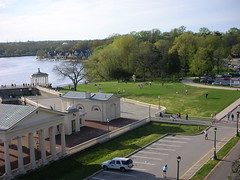
Apparently a photo I took while out one sunny day in Philadelphia has been selected as a finalist for a Schmap guide. This is the second time a photo of mine on Flickr has been noticed; a newspaper asked me for permission to use a photo I took of David Blaine in the fishbowl in NYC (remember when he lived underwater for 9 days in Lincoln Center?).

I'm generally not a talented photographer, but I guess blind squirrels really do find nuts once and a while.

06 April 2008

Idiocy of air travel

I flew out to Pittsburgh this weekend to re-visit the University of Pittsburgh School of Medicine. The flight to Pittsburgh was delayed two hours so my scheduled 7:10pm flight became a 9:10pm flight. There was another flight scheduled to leave at 9:00pm, also for Pittsburgh, which was running on time. After an announcement that the 9pm plane was not full, most of the people (including me) on the delayed 7:10pm flight rebooked onto the 9pm flight. At 9:10 they began boarding both flights simaltaneously. The delayed 7:10 flight was now practically empty, with fewer than 50 passangers booked, so I ran back to the counter and rebooked again, back onto the 7:10 flight.

I arrived in Pittsburgh at about 10:40 and headed straight to the tram that runs between the flight terminal and the baggage/ticket terminal. The tram broke down and we were stuck for about 20 minutes. Since we were in a tunnel our cell phones didn't work and no one was answering the emergency call button. Eventually the tram re-started and we made it to the baggage terminal.

I immediately headed outside to grab the bus into Oakland (a neighborhood in Pittsburgh) and watched one depart just as I got there. 30 minutes in the cold and another bus arrived (it's now a bit past 11:30pm). Who turns out to be on the bus? A former student of mine from when I was an economics TA who now hates his job in finance.

I did manage to get to my host MS1's apartment around 1am. I left my apartment at 5:10pm. That's almost eight hours and I didn't even leave the state.

31 March 2008

Clinic redux

Last Friday I shadowed an outpatient neurology clinic as I do once or twice a month; here are the highlights.

1. Childhood narcolepsy. This is diagnosed using a sleep latency test; abnormally quick decent into slow wave sleep indicated narcolepsy. Unfortunately, the normative data for children doesn't exist so it can be hard to definitively diagnose. An EEG is also a good idea to rule out seizures.

2. Autism. I've never seen autism to this degree before; the appointment was because of an increase in obstinate behavior. The child was barking intermittently and would lunge for any paper he saw (to eat it). He was pulling the threads out of his sweater and eating those too. The parents looked haggard and completely worn out; dad would jump at the slightest noise. Three clinicians saw the boy together to determine whether antipsychotics should be started or whether the current medications should simply have their doses tweaked.

3. Refractory status epilepticus. An adopted child who has failed five different kinds of anticonvulsants. In the last two weeks there have been no seizures, but the week prior there were two: 75 and 90 minutes in duration. An MRI and overnight EEG are on the table as the first step towards consideration of neurosurgery.

4. Cerebral palsy. Not usually something we see unless it's part of a larger issue, which, in this case, it was. We just don't know what the larger issue is. The part I want to bring up is that the leg muscles can get tight and force the knees to turn inwards. This realigns the hips; if left uncorrected, the hips can become painfully and permanently displaced.

5. Absence seizures with syncope. I have now met two children with this seizure type: they lose consciousness for the duration of their seizure. Invariably they are worked up by cardiology first and when they don't find anything, they send them to us and we hook them up to an EEG.

Daffofils

They evoke the strongest memory of school in England.

29 March 2008

Why so popular?

It mystifies me that the hands-down most often keyword-searched page on my blog is this post from July 26, 2006. It is far and away the most frequently visited page of my blog.

It turns out that if you google the words "screwdriver" and "chest," my blog comes up first. Cool.

Choosing a School

I am sitting in the law library (view from my chair, right) working on my biochemistry term paper on dentatorubral-pallidoluysian atrophy (DRPLA), but my mind keeps wandering. I have now heard from all my medical schools and must begin choosing where I want to spend the next four years. I have narrowed it down to three at which I have been accepted: Michigan, Mt. Sinai or UPitt or two at which I have been waitlisted: WashU or UPenn.

I am content to live in any of the above cities and they will all cost me about the same amount of money, so how do I choose? I am so paralysed by the decision that I have actually asked several of the attendings I know at the hospital to rank them for me (which they did: Upenn got 3 votes and WashU got 1 for the top spot).

I think what makes it so difficult is that I would be happy at any of these schools. All of them set me up well for the future; there is no wrong choice. I am extremely fortunate to be in this position and I recognize that. But I still have to choose. And I am still stuck.

In the meantime, this paper still needs to be written. Back to biochem.

25 March 2008

Neonatal pre-op MRIs

One of the research studies I am involved in at the hospital includes performing an MRI immediately prior to the heart repair surgery of TGA and HLHS babies*. The baby we studied yesterday was oversized (due to mom's diabetes), but otherwise stable. The MRI revealed PVL,** which we have seen in 20% of patients prior to their surgery, and also a temporal lobe hemorrhage. We immediately called the surgeon to the MRI suite and a discussion ensued: what is the bigger danger - delaying the heart repair or potentially enlarging the bleed (the surgery would involved heparin, a blood thinner)?

We decided to delay the surgery and re-image the child in a few days to re-evaluate.

Sitting in on that discussion reminded me why I want to be a doctor. I've been losing the faith a bit with all the paperwork that is my job recently and this year long illogical waiting game of frustration that is applying. It was nice to have a reminder; hopefully I will get another one this Friday in clinic.

- - -
*TGA = Transposition of the great arteries. The aorta is connected to the right ventricle and the pulmonary artery is connected to the left ventricle, creating two independent circulations.
HLHS = Hypoplastic left heart syndrome. The left ventricle fails to form and the aorta is small and insufficient. Once the ductus closes, there is no systemic circulation.
**PVL = Periventricular leukomalacia, a white matter injury that occurs in pre-mature babies and is thought to be associated with mild cognitive problems.

24 March 2008

23 March 2008

When I grow up

Now that I am settled on becoming a physician, the next logical decision is what kind of physician I want to be? Granted, there are rotations in third year to help me decide. I can shadow practitioners to make an informed choice and then, of course, I must match in the specialty I hope for. But what am I hoping for? Surgery? Emergency medicine? Pediatrics?

My colleagues that the hospital have their opinion: surgeon. My friends in their internships have theirs: neonatal intensive care.

But the best way to solve this problem is clearly to take some form of internet quiz. So I took the Medical Specialty Aptitude test on the University of Virginia Health System website. Apparently, my top 5 specialties are:
1. Nephrology
2. Thoracic surgery
3. Aerospace medicine
4. Plastic surgery
5. Pathology

I no longer put any faith in internet quizzes.