05 December 2007

Bummer

I had a little abstract prepared to submit to the Pediatric Academic Societies annual meeting (in Hawaii). It's customary to run these things by the Director(s) of the department(s) relevant to the abstract. Well, one of them killed my abstract. He won't let me submit it. Boo. And not because it's bad science, but because he's afraid we'll lose referral business.

Medical school admissions update

Left: Chasing sunset on a plane to St. Louis.

Applications completed: 23
Interviews offered: 12
Rejections: 3
Acceptances: 3

Organic Lab

Catalytic Hydrogenation of 4-cyclohexene-cis-1,2-dicarboxylic acid. We used a syringe to inject sodium borohydride while boiling the solution with chloroplatinic acid and activated carbon in a steam bath. The inflated balloon indicates that hydrogen gas is being produced and thus the solution is under pressure (sealed container).

It's exciting because I used a syringe. Twice.

26 November 2007

THE reason to get a Wii

Guitar Hero.

I played it for the first time this weekend.

A Mazing.

Even XKCD commented: Comic 70

Song added to my playlist because of Guitar Hero: Monsters by Matchbook Romance

Le Nozze Di Figaro

On Saturday night we headed to the Metropolitan opera to see Bryn Terfel and Simon Keenlyside in The Marriage of Figaro. It was a spectacular performance, but Anja Harteros stole the show. She played the Countess and received a longer standing ovation than either Terfel or Keenlyside. Her act II aria "Porgi, amor" and act III aria "Dove Sono" were riveting. Ekaterina Siurina was a lackluster Susannah in the midst of such a powerhouse cast; really only shining in her act IV aria "Deh! vieni, non tardar." It was only too apparent in the act III duet "Sull'aria" which soprano was carrying the show. There were two hilarious moments; one when a prop rolled off the stage and hit a cellist in the head (she finished the act and left), and another when Figaro motioned to Susannah to spank him in Act IV. Clearly, the Met and Terfel have a sense of humor.

On a different note, the dinner we had afterwards was also quite spectacular. Yum.

20 November 2007

17 November 2007

11 November 2007

Bacon or Chocolate?

In Vegas three of us discussed a theory that any food could be improved when accompanied by either bacon or chocolate. Some are an easy call: a turkey sandwich calls for some bacon while a cheesecake calls for chocolate.

Now I would have put Diet Coke in the chocolate column, but apparently I was outvoted because somewhere you can get Diet Coke with Bacon.

Question though... diet coke is kosher. Is diet coke with bacon?

In Boston?

This appears to be a wild turkey. He was just ambling around the block in the rough vicinity of MIT. I would posit that this is a dangerous time of year for a large, tasty turkey to be out for a stroll.

06 November 2007

...awkward...

About five minutes into my (non-Harvard) medical school interview...

Faculty interviewer: Have you ever been to Boston before?
Me: Yes, once. It's a great city.
Faculty interviewer: Was it to interview at Harvard medical school?
Me: ... yes.
Faculty interviewer: What did you think? You're exactly the type of person they like.
Me: Well, I think has good and bad qualities like every other school.
Faculty interviewer: What about UPenn, when are you interviewing there?
Me: I don't have an interview there.
Faculty interviewer: Yet. My daughter went there. She lived in University city. You don't want to live in the ghetto though. She almost went to Columbia, are you interviewing there?
Me: They have not invited me either.

I actually ended up liking the guy, but what a stressful start!

31 October 2007

A month of travel

Someone emailed to remind me I haven't posted in a month. True. And I have no excuse because my hotels had internet access. I was in Pittsburgh, Boston, and Atlanta to interview at medical schools and in Vegas to, well, blow off some steam.

For those of you keeping score, I have 9 interview invites, 2 rejections, and 12 haven't-heard-yets.

Tomorrow I have my neuroanatomy midterm (yikes) for which I am incredibly unprepared. This is partially due to travel and work and partially due to my going to Vegas instead of studying.

Vegas was phenomenal. I gambled (and won - Pai Gow!), first with someone else's money (what better way to learn) and then with my own. I ate (a lot), I sunned by the pools (tan = no, bikini debut = yes), I watched sports and drank beer in the sports book (go Steelers go Rockies), and I went clubbing (VIP, skybox: balcony over the dance floor = awesome). I took a red eye back, went straight to work and ended up in bed by 8:30pm (totally exhausted) for a nice 11.5 hour snooze. Four days of fantastic.

Flash back to now... sore arm from a flu shot, totally unprepared for a midterm, pre-lab to write and more travel to come. Oh, and I'm cold (not a surprise).

The next two weeks: Nov 5-6 Boston, Nov 7 NYC, Nov 12-13 Cleveland, Nov 15-16 Ann Arbour

If I get in somewhere (two letters potentially on their way) - you bet your cute little butt I'm gonna post.

27 September 2007

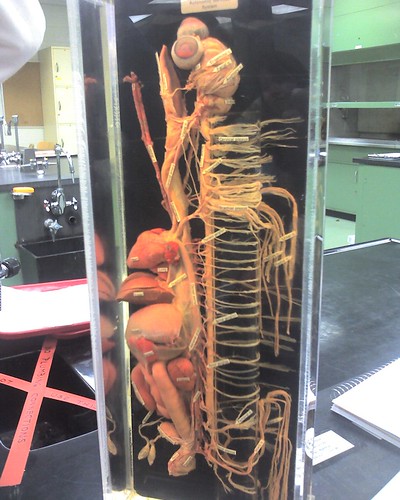
Spinal Innervation

We did the entire spinal cord in one night in neuroanatomy lab. Granted, from a gross dissection point of view, a lone spinal cord is not much to look at. But when you consider the rather extensive innervation it becomes quite a daunting task.

Which organs, muscles, and body parts are innervated by which nerve tracts? How many interneurons for this system and what kinds of reflexes are involved? What will sympathetic or parasympathetic activation lead to? Which lamina of the vertebrae are receiving this type of input?

For those of you with some bio/neuro, recall that activation must also involve some reciprocal inhibition, so even a basic (monosynaptic) stretch reflex stimulates a cascade of firing.

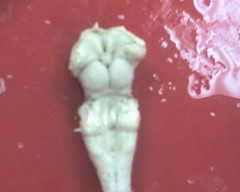
I think next week we move up the brainstem to the medulla (mylencephalon). And we'll get our exams back. Ick.

26 September 2007

Defending the men

Apparently there is a happiness gap between men and women: the women are less happy. When economists and readers of the New York Times were asked to explain the gap, the usual suspects were brought up: women are expected to do more (paid work and house work) and suffer under the societal standard of being and looking perfect. This whole problem was then laid squarely at the feet of the men and their apparent expectations and laziness.

This is totally unfair.

First, a huge percentage of what we do is to impress other women, not men. A decent proportion of these "standards" come from women's magazines - one big reason I don't read them. It's time to accept that you cannot and will not be perfect at everything and that the only person annoyed by that is you, not your husband/boyfriend/father.

Second, men do no expect us to look like supermodels all the time. In fact, there a lots of men who prefer a girl in jeans who will eat a burger and go for a hike than one who is in 3 inch heels, a mask of make-up, and refuses to eat non-lettuce items. And this cuts both ways, the perfect male physique is shown in movies (Brad Pitt) and on magazine covers, they have the same pressure we do.

Third, when was the last time you asked a guy to help with the housework? I am willing to bet if you sat down and divided the duties, you would be pleasantly surprised with how much they're willing to help out. In fact, I know plenty of men who are quite happy to stay at home more while the wife builds a career.

It's time we stop blaming men for our lot as women and shoulder some of the responsibility ourselves. Why are young girls unhappy? Because other girls are so mean (remember the book on sororities... girls can be vicious). Who is creating this pressure to be the perfect everything all at once? We are.

24 September 2007

Neuroanatomy


The first neuroanatomy exam is Wednesday so I am, of course, furiously trying to cram names like sulcus limitans and stria habenularis into my brain. I labeled photographs, I have made lists of key terms, I have flipped through slide sets and I have read the textbook and somehow this subject flummoxes me. Well, not the material itself, but rather, what is the best and most efficient way to study it?

It is great practice for medical school, where will have to learn more than just neuroanatomy. If I can figure out a strategy for this class then maybe I'll be a step ahead in general anatomy. If.

19 September 2007

Medical school admissions update

# applications initiated: 27
# secondaries received: 25
# secondaries completed: 22
# confirmed complete apps: 20

# interviews offered: 6
# acceptances: 0
# rejections: 1

07 September 2007

I deserve a cookie.


A moment of victorious immodesty: I just cranked out a 115 page IRB protocol for constraint-induced movement therapy in 4.5 days.


update: It was pushed to the October 3rd review. : (

19 August 2007

Seen in NYC

"Beware of enterprises requiring new clothes." -Thoreau

Apparently, if you're dressed entirely in white, you can lawn bowl or play croquet on dedicated, manicured lawns in central park. Who knew?

Also seen in NYC this weekend: A man on a drag racing tricycle still living the funk, a dog wearing a pearl necklace collar, and a trumpet & tuba band playing (and wandering) the upper West side at 10:30pm.

Overheard in NYC this weekend:
uncle: I really like our hotel here. The location and service are great.
niece: Do we get HBO on demand?
uncle: I don't know.
niece: I don't like it then.

And to end... a nice bit of procrastination: me. Simpsonized.

10 August 2007

Paying doctors less

There was an article in the New York Times recently arguing that the best and fastest way to decrease the cost of health care in the short term was to pay doctors less. I think the best way to decrease health care costs is to pay lawyers less. After all, less pay means fewer lawyers, fewer lawyers means fewer lawsuits, fewer lawsuits means lower malpractice insurance, lower malpractice costs leads to lower patient care costs. And honestly, what part of society, health care or otherwise, wouldn't be better served with fewer lawsuits?

Regardless of my lawyer pay scheme, there are several important reasons not to lower the pay of doctors and arguably, to increase it.

First, becoming a doctor incurs more debt than any other profession so salaries are needed that can cover the cost of living and the cost of paying back loans. In 2006, the average medical student graduated medical school with $130, 571 in educational loans (that does not include loans to cover the cost of living, which average another $16,689) with 72% of graduates carrying a debt load greater than $100,000. That's an 8.5% increase over the previous year (1). Assuming a 5% interest rate, a graduate needs to budget $7,363 per year just to cover the interest on the loan.

Which brings me to the second point. Doctors make almost no money until after their residency. For example, the pay schedule for residents at UT Southwestern in Texas is listed below (2). That's a 3-4% increase annually, which barely tracks the current inflation rates (3). So a medical resident is carrying a six figure debt load and earning roughly the same salary as the maintenance workers (4) (who I assume have less school debt and little specialized training). Now lets consider that residents work at least 80 hours per week, while the maintenance worker pulls only 40. Hourly, a resident makes less than a babysitter. Compare that to a law school graduate who gets a job at a large law firm and receives an average starting salary of $99,000 (5).

Third, there is the effect on lifetime salary. While most twenty-somethings are paying nice sums into their401K and reaping the benefits of matching funds and compounding interest, medical graduates are paying all their money to their creditors. Considering the average entrance age into medical school is 24 (6) and most residencies are at least 3 years, a medical graduate will be 31 before they have a chance of receiving a salary that would allow them to save for retirement or pay off the principal on their loans.

Lastly, let's look at who in the medical field is getting particularly high salaries and why. Your GP is probably barely covering the cost of his/her practice, not making millions per year. At the hospital I work in, there are some doctors pulling seven figure salaries, but they are highly specialized: pediatric cardio-thoracic surgeons for example. That surgeon did 13-14 years of post-medical school training so he was in his forties before he made any money. If you paid doctors like him less, no one would go through the incredibly lengthy training, take on that level of risk, or be able to retire before 80.

There are a few rock star dermatologists or plastic surgeons who command high salaries, but there are a few people like that in every profession. Their wages are not indicative of the thousands of doctors practicing every day and those are the doctors that will be put out of business if salaries are lowered. Not to mention how many fewer bright young people will aspire to become physicians instead of bankers or lawyers. Paying doctors less is not the answer; the result from reduced pay is fewer doctors and therefore longer waits and a lowered standard of care.


Sources
(1) http://www.ama-assn.org/ama/pub/category/5349.html
(2) http://www8.utsouthwestern.edu/utsw/cda/dept200270/files/214265.html
(3) http://inflationdata.com/inflation/inflation_rate/CurrentInflation.asp
(4) http://www.co.monterey.ca.us/personnel/SalaryPost.asp?jt=72C19
(5) http://www.collegejournal.com/salarydata/law/
(6) http://www.vault.com/articles/The-History-of-Medical-Schools-in-the-U.S.-27653519.html

06 August 2007

Perpetually connected

I have joined the ranks of the perpetually connected... it's no longer my shadow and me, but instead, my Treo and me.

And I'm thrilled.